



FAQs
How does social media marketing function as a growth channel?
Social media marketing is using platforms like Instagram, LinkedIn, and TikTok to build brand awareness, engage audiences, and drive business outcomes like leads and sales. It covers organic content, paid ads, influencer partnerships, and community management working together.
How much does social media marketing cost?
Costs range from $1,000/month for organic-only management to $25,000+/month for full-service enterprise campaigns, depending on scope and company size. The right budget depends on how many platforms, how much content, and whether paid ads are involved.
Which social media platform is best for my business?
It depends on where your audience actually spends time and what you're trying to achieve. B2B brands typically lean on LinkedIn, consumer brands do well on Instagram and TikTok, and local businesses often see the most value from Facebook.
How often should I post on social media?
Consistency matters more than volume; 3–5 quality posts a week usually outperform daily filler content. It's better to sustain a realistic cadence than burn out chasing a schedule that isn't tied to actual results.
Do I need to be on every social media platform?
No, spreading a team across six platforms usually means doing all of them poorly. Start with one or two platforms where your audience is genuinely active, prove the strategy works, then expand.
How is AI changing social media marketing?
AI for social media marketing is speeding up nearly every part of the process: content creation, ad targeting, listening at scale, and attribution modeling. It doesn't replace strategy or creative judgment; it just helps teams act on signals faster.
Should I hire an in-house team or an agency for social media?
In-house teams offer deep brand alignment and speed on internal decisions, while agencies bring a full bench of specialists and tooling without the overhead of hiring five people at once. Many mid-market and enterprise brands land on a hybrid of both.
Somewhere right now, your potential consumer is scrolling through different social media platforms. They are watching a Reel, skimming a LinkedIn post, or reading through a serious debate in the comments section of a Facebook post.
This is what social media marketing is all about: showing up in the conversations instead of leaving your brand’s reputation to chance. However, the means for this have transformed significantly.
Pick a platform, schedule a post, hope customers engage- that old model of social media marketing simply doesn’t work anymore. Platforms don’t distribute content evenly; they reward what their algorithms are favoring this week, and that shifts constantly.
We’ve watched this shift happen up close. Based on our research and experience working with global brands, we believe that the brands winning attention aren’t necessarily posting more.
They’re reading the signals faster: what’s trending before it peaks, what format a platform is currently pushing, which post is worth backing with ad spend the moment it starts moving.
The strategy hasn’t changed; the speed at which you need to execute it has. This social media marketing guide is built from that vantage point.
It covers the entire discipline, from building a strategy tied to real business goals and choosing the right platforms, to creating content people actually want. It’s also about growing your reach without inflating your budget, protecting your brand when things go sideways, and proving to leadership (in numbers) that social is working.
A Quick Overview of Social Media Marketing
Social media marketing is the practice of using platforms like Instagram, LinkedIn, YouTube, TikTok, X, etc. to build your brand. It’s how you reach your target customers and drive valuable business outcomes. And it rests on three components: content, distribution, and measurement. It’s a discipline built on the following components: content, distribution, and measurement.
Social Media Marketing vs. Social Media Management vs. Social Media Advertising
These terms are mostly used interchangeably, but they shouldn’t be. Although they have different meanings for your business.
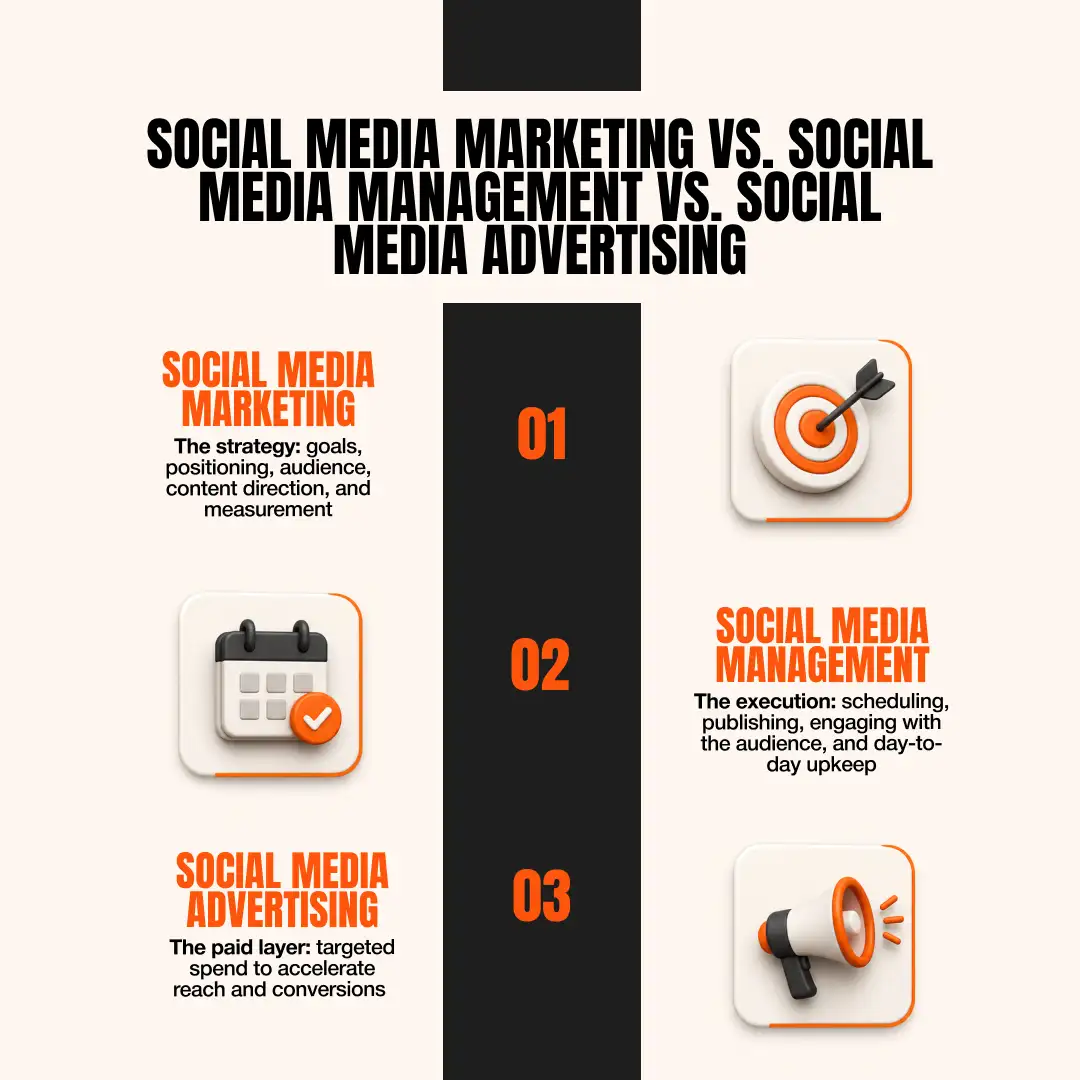
In short, marketing is the why and the what, management is the how, and advertising is the paid accelerant.
Different Ways Brands Show Up on Social Media
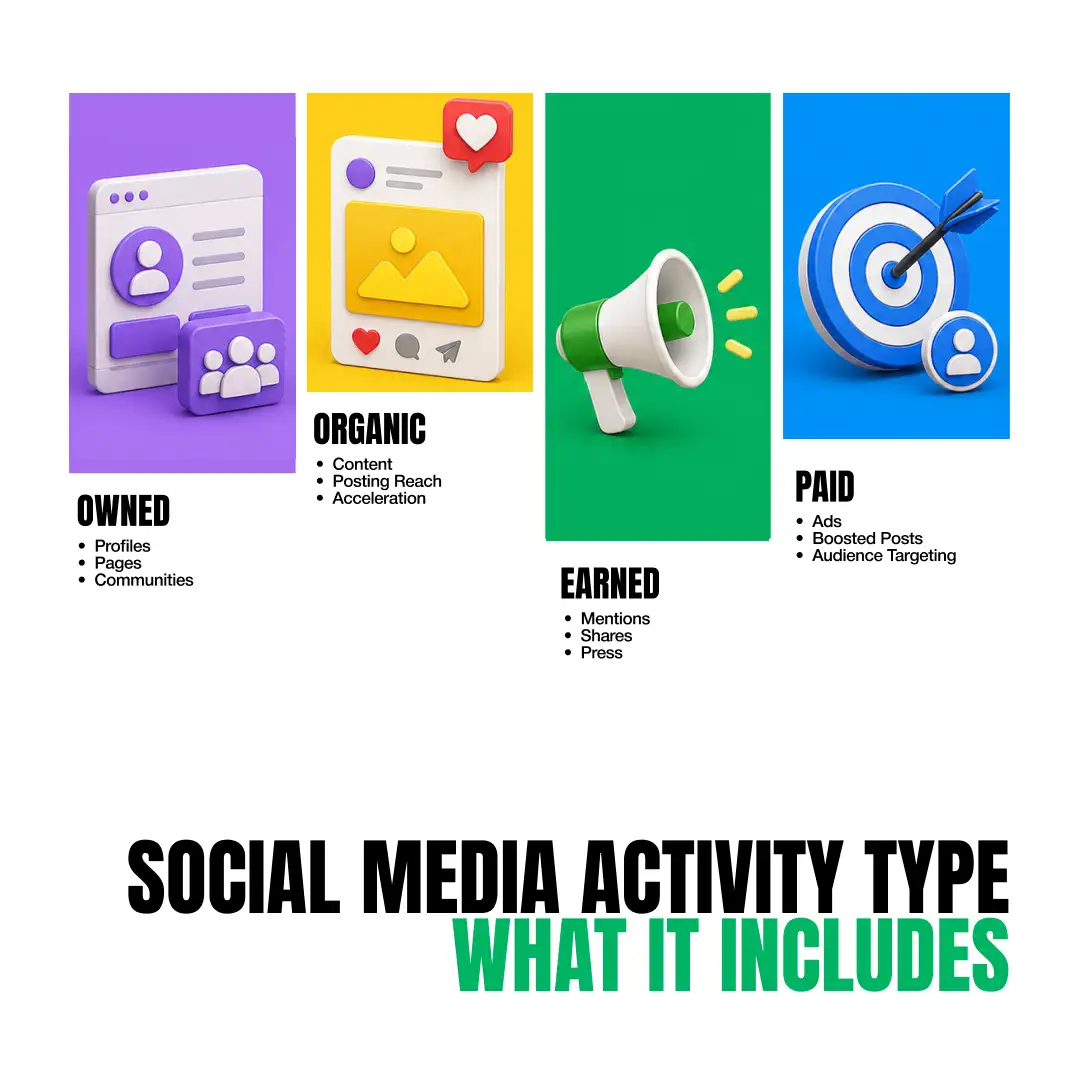
| Social Media Activity Type | What It Includes |
| Owned | • Profiles• Pages• Communities |
| Organic | • Content Posting• Reach Acceleration |
| Earned | • Mentions• Shares• Press |
| Paid | • Ads• Boosted Posts• Audience Targeting |
Your brand’s social media activities will fall into one of four buckets-
- Organic: the content you post without paying to accelerate its reach
- Paid: ads and boosted posts you pay to show to a specific audience you choose
- Earned: mentions, shares, or press you didn’t pay for or post yourself
- Owned: your actual profiles, pages, and communities
Want Your Social Media Content to Win the Algorithm?
Leverage strategies that drove a 180% jump in organic reach and 3.2x follower growth.
Understanding Different Types of Social Media Marketing
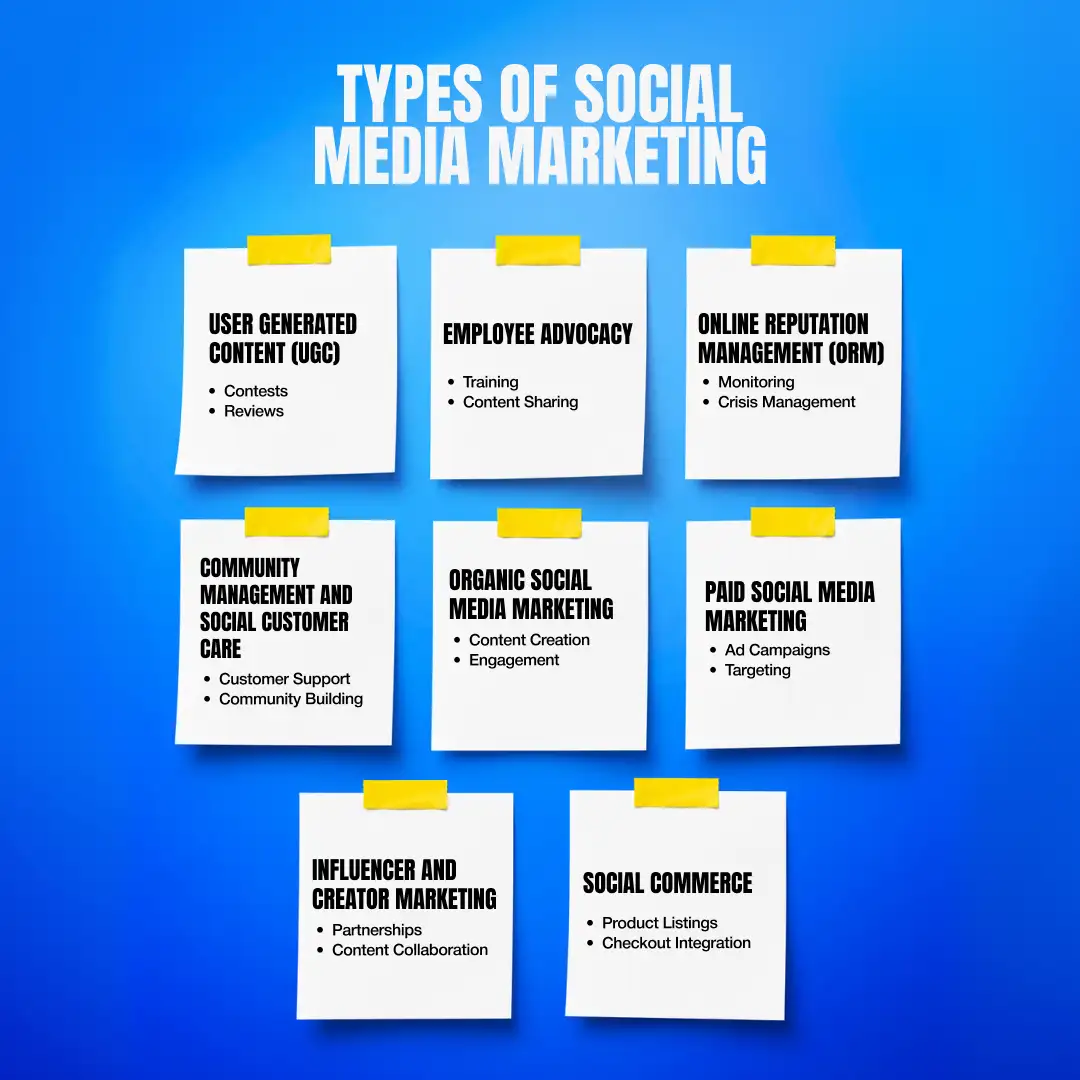
Social media marketing isn’t one activity; it’s several disciplines that work together. Each one needs a different set of tools, a skill set, and a budget. Here’s a quick glance at the different types-
-
Organic Social Media Marketing
This is the foundation most brands build on first. Organic social media marketing includes posting content without any paid promotions behind it. It’s slower to scale and is largely impacted by the shift in algorithms. But it’s also where brand voice, community, and trust actually get built.
-
Paid Social Media Marketing
This includes sponsored content and ads that are specifically placed in front of the targeted audience. This is basically the reach businesses buy instead of earning. This is the best lever for visibility, especially for a new brand with no existing following.
Start by allocating a smaller budget for the paid ads, optimize based on real performance, and scale once something’s proven to work for you.
-
Influencer and Creator Marketing
Influencer or creator marketing is the trendiest form of SMM. It means partnering with creators who already have an audience’s trust. So, your brand borrows credibility instead of building it from zero.
The strongest partnerships aren’t about follower count; they’re about fit. A creator with 20,000 highly engaged, relevant followers usually outperforms one with 500,000 who has no real connection to the category.
At scale, this becomes an execution challenge as much as a strategy one, sourcing, vetting, and contracting dozens of creators. The real work is coordinating them to publish within the same tight window, so a campaign lands as one wave of impressions instead of a trickle spread over weeks
-
Social Commerce
This kind of social media marketing includes selling directly on the platform. It includes shoppable posts, in-app checkouts, and live shopping. It significantly shortens the distance between discovery and purchase.
-
Community Management and Social Customer Care
This is nothing but responding to comments, DMs, and mentions in real time. This type of marketing is based on the ongoing relationship work that keeps your audience active and engaged during the campaigns. If done well, this alone can build strong loyalty for your brand because it’s proof that you are being considerate of your customers.
-
Online Reputation Management (ORM)
This is about keeping track of what people are saying about your brand across platforms, reviews, and public conversations, then stepping in before things spiral.
It’s less about daily back-and-forth and more about catching sentiment shifts early and managing the narrative when something goes wrong. Done right, ORM is the difference between a brand that gets ahead of a crisis and one that gets buried by it.
-
Employee Advocacy
This means equipping employees to share brand content through their own personal networks, extending reach through voices audiences already trust more than a corporate account. People trust people. A message shared by an employee routinely outperforms the same message posted from the brand’s own page.
-
User Generated Content (UGC)
This includes content created by customers, reviews, tags, unboxing videos, and more, repurposed as brand marketing. It’s some of the highest-converting content a brand can use, simply because it comes from someone with nothing to gain by lying about the product.
Organic Vs. Paid Social Media Advertising
Before getting into the head-to-head comparison between the two, you need to understand that organic and paid marketing are not competitors; they are different stages of the same funnel. Organic proves that an idea works, and Paid makes sure it reaches more people.
| BASIS | ORGANIC | PAID |
| Cost | Free to post, costs time and resources | Requires significant ad spend |
| Reach | Limited, algorithm-dependent | Scalable, budget-dependent |
| Speed | Slow to build | Fast, immediate visibility |
| Best For | Brand voice, trust, community | Launches, lead gen, scaling proven content |
| Control | Low: The algorithm decides the distribution | High: you decide who sees it |
| Longevity | Compounds over time | Stops the moment the spend stops |
-
Why Organic Reach Has Declined
With organic marketing, posts once reached almost all of a brand’s followers automatically. Today, they typically reach only a small percentage, which is one of the main reasons social platforms rely so heavily on advertising revenue.
With an increasingly crowded feed by creators and competitors, a post that could earlier reach thousands now struggles to reach even hundreds.
-
When to Introduce Paid Amplifications
Paid spend works best backing something that’s already proven itself, not propping up content that isn’t landing.
A few clear signals that it’s time:
- An organic post is outperforming your usual engagement; back it before the moment passes
- A new account has no existing audience to reach organically
- A launch or campaign has a hard deadline that organic growth can’t hit in time
- Retargeting warm traffic, people who’ve already engaged, for a lower-cost conversion
This isn’t a small shift in spend either: Gartner’s 2026 CMO Spend Survey found CMOs are now allocating 15.3% of marketing budgets specifically to AI initiatives, with paid media still commanding the largest single share of the overall marketing budget.
-
AI in Ad Targeting and Creative Optimization
AI for social media marketing has changed how fast this testing cycle moves. Instead of a human manually reviewing performance across a dozen ad variations, AI models process the results in real time. This helps businesses reallocate spend toward what’s converting and away from what isn’t, often within hours instead of days.
The market is scaling fast to match this shift; the global AI for sales and marketing market is projected to reach $240.58 billion by 2030, with generative AI-driven ad targeting and creative testing cited as one of the fastest-growing segments.
Why Social Media Marketing Matters to Your Business
Being on social media is not optional infrastructure; this is where your customers discover your brand, trust it, and make buying decisions.
As AI marketing agencies reshape the game with smarter targeting, predictive insights, and hyper-personalized content, staying ahead means partnering with experts who know how to blend AI-driven precision with human creativity.
Here’s why social media marketing plays a significant role for your business —
-
Brand Awareness and Discovery
Most buyers aren’t typing brand names into a search engine anymore; they find you mid-scroll- reels, a recommended post, or a friend’s share. The brands that get discovered consistently are showing up in the right format, on the right platform, at the moment the algorithm is actively pushing that kind of content.
-
Direct Customer Relationships and Trust
Your website is a monologue, and your social media profile is a conversation. It is the only channel where your customers can comment, DM, tag, and interact with your brand.
When a brand replies to a comment, addresses and resolves a complaint publicly, or shows up as a real voice instead of just a logo, it earns credibility and trust that advertisements cannot build.
-
Cost Effectiveness over Traditional Advertising Methods
A national TV spot or a billboard campaign requires a budget most businesses can’t justify spending. Social media marketing does not need it.
A single well-targeted post can reach a precise audience for a fraction of traditional media spend, and unlike a billboard, you know exactly who saw it, who engaged, and who converted.
This is also where paid social outperforms old media on efficiency: budgets can be tested at a small scale and optimized in real time.
-
Visibility in AI Search and LLM Citations
Search itself is changing. When people ask ChatGPT, Perplexity, or Claude for recommendations, these tools pull from the same social conversations happening on LinkedIn, Instagram, and Reddit, not just your website.
A strong, consistent presence on these platforms increases the odds that your brand gets cited when someone asks an AI for a recommendation in your category. Brands that show up actively and credibly across social are simply more likely to be the answer, not just a result on page two.
-
Real-Time Market Research and Social Listening
Every comment, share, and mention is a data point most businesses used to pay research firms for.
Social listening turns that noise into a signal: what customers actually think, what competitors are doing well, where the market is shifting before it shows up in a quarterly report.
AI-powered listening tools have made this practical at scale: tracking millions of mentions and conversations in real time, so brands catch a shift in sentiment or a competitor’s misstep the moment it happens, not weeks later.
Here is a list of probable business goals and how social media delivers on them-
| Business Goal | How Social Media Delivers It |
| Brand awareness | Puts your brand in front of audiences discovering products through their social feeds |
| Customer trust and loyalty | Public, responsive engagement builds credibility for your brand |
| Lead generation and sales | Targeted content and paid campaigns move followers towards a purchase decision |
| Cost-efficient marketing | Precise targeting and real-time optimization outperform traditional media spend |
| Market & competitive intelligence | Social listening surfaces customer sentiment and competitor moves as they happen |
| Customer service | Public resolution of issues turns support into a trust-building moment |
How To Run a Social Media Marketing Campaign Successfully
A successful social media marketing campaign is not just about a single post that goes out on the launch day. It’s a sequence of decisions that ultimately influence your revenue. Here’s how that sequence typically plays out-
- Catch the moment before it peaks
Every social media marketing campaign starts with timing, not creativity. Before a single asset gets made, you need to know what your audience is already paying attention to and how that’s shifting week to week.
This is where AI-powered social listening tools do the heavy lifting, scanning conversations, competitor activity, and emerging formats in real time. This analysis ensures that you’re building toward something that’s rising, not something that already crested last month.
- Move from idea to asset, fast
Once you know what to make, speed becomes the differentiator. You need to push from concept to publish-ready content before the window closes. AI tools have compressed a lot of this timeline: scripting, editing, resizing for five different aspect ratios, generating first-draft copy.
None of that, of course, replaces a strategist’s judgment on what’s actually worth publishing, but it does mean less time lost to production logistics and more time spent on the idea itself.
- Let performance data guide the next move, not gut feel
A campaign doesn’t run on autopilot once it’s live. The first 24–48 hours tell you a lot: which post is resonating, which format is falling flat, where engagement is coming from.
This is the point where teams used to wait for a weekly report. Now, performance tracking can flag an over- or under-performing post same-day, so adjustments happen while the campaign is still live instead of in a retrospective.
- Back what’s already working
Not every post deserves ad spend, but the ones already gaining organic traction usually deserve more reach than the algorithm alone will give them. Layering paid amplification behind proven content, rather than guessing upfront, tends to produce a better return than spreading budget evenly across everything you publish.
- Trace the campaign back to a business outcome
A campaign isn’t finished when the posts stop going out. The real test is whether it produced something the business cares about: leads, sign-ups, sales, or brand lift that shows up in the next set of numbers.
Attribution tools powered by AI now make it possible to connect a specific post or ad to a downstream action, closing the loop between “this got engagement” and “this got results.”
Expert Tip: Treat each campaign as a loop. What you learn from one run- what content earned reach, what format got backed with spend, what actually converted- should directly shape the next one.
Setting Social Media Goals That Tie to Business Outcomes
A generic goal like ‘grow our Instagram ’ isn’t a goal; it’s a wish. Without a number and a deadline attached, there’s no way to know if your strategy is succeeding or not. Every goal on your list should trace back to something that your business already cares about.
-
The SMART Framework for Social Goals
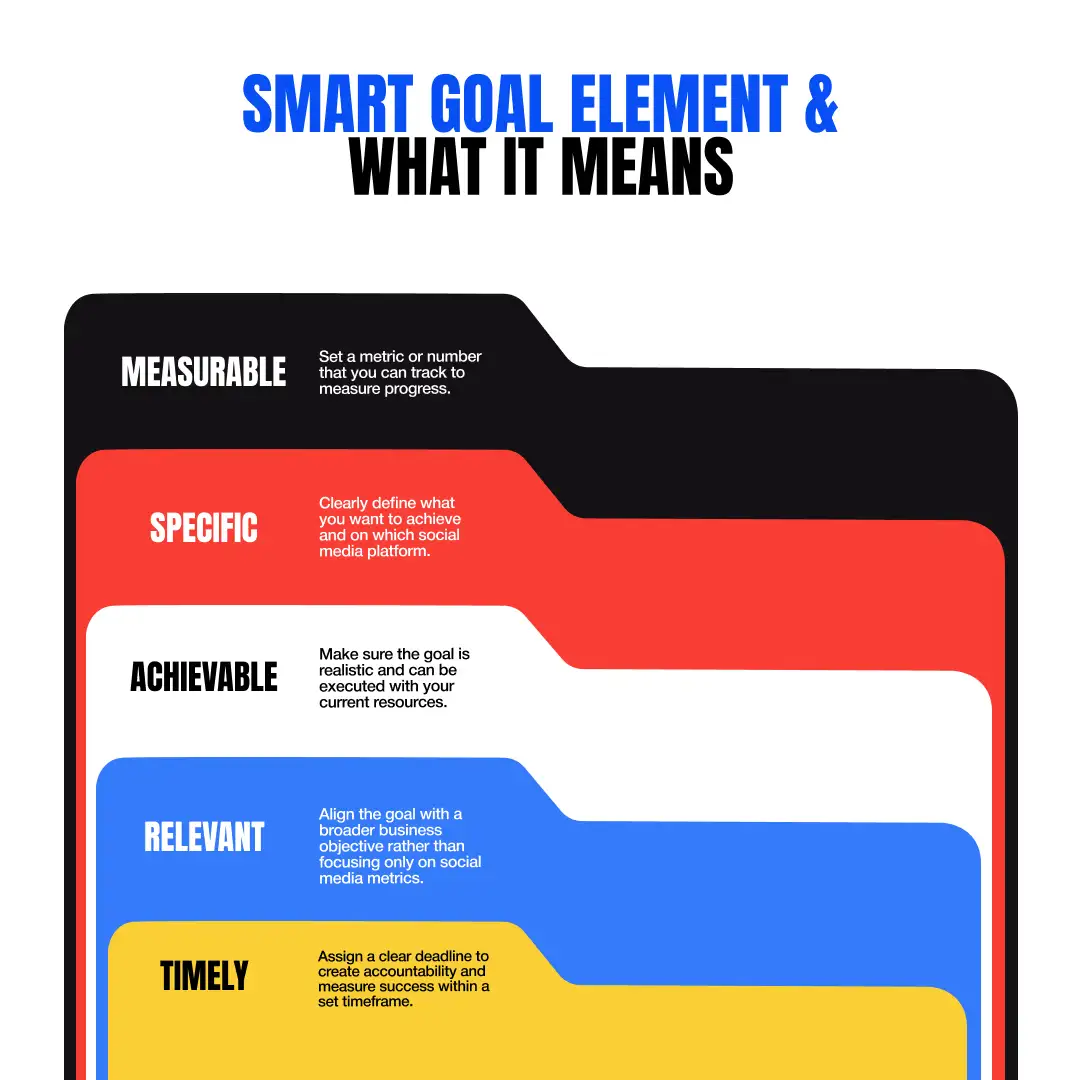
SMART goals force specificity into a discipline that defaults to vague ambition. Each goal should be:
- Specific: what exactly are you trying to achieve, on which platform
- Measurable: a number you can actually track
- Achievable: something your team can actually execute given current resources
- Relevant: tied to a business objective, not a social metric in isolation
- Timely: a clear deadline, not an open-ended ambition
-
Common Goal Types
Most social goals for businesses belong to one of these six broad categories-
- Awareness: reach, impressions, share of voice
- Engagement: comments, shares, saves, watch time
- Lead generation: form fills, sign-ups, demo requests driven from social
- Sales: direct or attributed revenue from social campaigns
- Retention: repeat engagement from existing customers, community activity
- Service deflection: questions are resolved on social media instead of a call center
Expert Tip: A brand launching in a new market needs awareness goals. A brand with traffic but no pipeline needs lead-generation goals. Do not pick one goal type and apply it everywhere, regardless of what the business actually needs right now.
-
Vanity Metrics vs. Metrics That Map to Revenue
A vanity metric, for instance, the number of likes on a particular post, shows that your brand got attention. A revenue metric, on the other hand, shows you what that attention was worth.
| Vanity Metrics | Revenue-Mapped metrics | Why Revenue Metrics Matter |
| Likes | Click-through rate (CTR) | Shows whether content actually drives people to act, not just react |
| Followers Count | Follower growth from targeted campaigns | Tells you if your audience is growing with people who fit your customer profile, not just anyone |
| Impressions | Engagement rate | Reveals whether people actually paid attention, not just scrolled past |
| Comments | Leads or conversions generated | Connects activity to real business outcomes, like a sale or sign-up |
This is where AI for social media marketing makes the real difference. It connects a specific post or campaign directly to a lead, a sale, or a support ticket resolved, instead of stopping the analysis at “people engaged.”
-
Getting Buy-In and Budget From Leadership
Executives don’t fund likes and engagement. They fund outcomes that they can clearly recognize: revenue growth, competitive advantage, cost reduction, etc.
The pitch that works isn’t “our engagement rate is up.” It’s “social drove X leads last quarter at a lower cost than our other channels”, a sentence with a number leadership already knows how to evaluate.
At Appinventiv Digital, when we ran this for Zoho, the ask wasn’t for more posts. It was a strategic video series built specifically for organic distribution, content engineered to earn reach on its own, not rely on ad spend to get seen.
It generated over 2M organic impressions and put Zoho’s product narrative directly in front of the enterprise audience that mattered. That’s the kind of result that gets a budget conversation extended, not questioned.
A few things make that case easier to build:
- Benchmark against competitors, not just your own past performance
- Present a small pilot budget with a clear hypothesis before asking for a large one
- Show the cost of inaction, what declining organic reach or a slower response time is already costing
Expert Tip: Budget conversations get easier once social stops being reported as a content function and starts being reported as a performance channel, sitting next to paid search and email in the same revenue conversation.
Choosing the Right Platform to Market Your Brand
Every platform has its own rules for what gets rewarded and who shows up to see it. Here’s a breakdown of what each one is best suited for, and the kind of content that actually performs there.
Platform selection is a part of social media basics, but it’s the step most brands rush past, and it’s usually why a strategy underperforms before it’s even had a chance to work. Here are the 3 key questions that will settle your decision-
- Where does your audience already spend time?
(not where you’d like them to be, but where the data says they actually are)
- What content can your team realistically sustain?
(A platform you cannot post consistently on is worse than the platform you are not on at all)
- Can this platform actually showcase what you sell?
(A B2B software company forcing itself onto a visual-first platform like Pinterest is fighting the medium; some products just don’t translate to certain formats, no matter how strong the content strategy is)
Expert Tip: Start with one or two platforms, prove the strategy works, then expand. Use AI listening and analytics tools to quickly spot which platform is actually driving engagement and conversions.
Social Media Trends Shaping the Next Wave of Marketing
The platforms, formats, and audience behaviors are shifting again. Here’s what’s actually changing the game right now and will impact future strategies as well.
-
Social Platforms as Search Engines
Younger audiences increasingly search TikTok and Instagram before they search Google. As per research among Gen Zs, about 41% prefer using social media over search engines to find information online.
That shift means your content now needs to answer a question, not just entertain. Captions, on-screen text, and video hooks are becoming searchable metadata, whether brands treat them that way or not.
-
AI-Native Content Creation, Editing, and Campaign Management
Content production timelines have collapsed. Hootsuite reports that 83% of marketers say AI helps them create significantly more content. Scripting, editing, and reformatting for five aspect ratios now happen in hours, with AI handling the repetitive parts of the workflow and a person still owning the creative call.
Campaign management is following the same pattern. Instead of manually checking performance dashboards each morning, teams now get flagged automatically when a post is over- or under-performing, so the reaction happens same-day instead of at the next weekly review.
This hasn’t lowered the bar for creative quality; if anything, it’s raised it. Brands with more time freed up from production logistics are investing that time in better ideas, not more volume.
-
The Authenticity Backlash Against Over-Polished Content
Feeds are full of content that looks like it came from a boardroom, and audiences have started scrolling past it at sight. More than 60% of product discovery now happens on platforms like TikTok, Instagram, and YouTube.
However, you need to beware of “AI slop”. Most users can identify AI-generated content and can lose interest in your brand. So, AI-assisted production only works when it’s still in the service of something that feels real.
Authenticity is fast becoming a scarce resource,” and that the bar is shifting from “‘can you create?’ to ‘can you make something that only you could create?
Adam Mosseri, CEO, Instagram
-
Short-Form Video’s Continued Dominance
Short-form video isn’t a trend anymore; it’s infrastructure. The global short video platforms market is projected to reach $3.24 billion by 2030.
What’s shifting is what kind of short-form wins. Platforms are actively engineering their algorithms to reward longer watch sessions: TikTok announced in late 2025 that videos over 60 seconds now receive a distribution bonus if they maintain strong watch-time metrics; a real narrative is starting to outperform a pure 15-second hook.
That shift raises the bar on production, since holding attention for 60+ seconds takes tighter scripting, pacing, and editing than a quick hook ever did, which is exactly where AI tools are stepping in, helping teams storyboard narratives, generate rough cuts, and test multiple pacing variations without multiplying production time.
So, you will soon need to use short-form videos as the core content pillar in your SMM strategies.

Fix What's Holding Your Social Media Back, On a Budget!
We'll run a free audit across your last 90 days of content, spot what's killing engagement, and hand you a fix-it roadmap.
Essential Social Media Marketing Tools
This social media marketing guide will be incomplete without mentioning the list of tools that can support and amplify your marketing efforts. Here’s a complete list of social media marketing tools for each step-
| Category | Top Tools | Primary Use Case |
| Scheduling & Publishing | Hootsuite, Buffer, Metricool | Queue and auto-publish content across channels |
| Analytics & Reporting | GA4, Sprout Social, Meta Business Suite | Track performance and prove ROI |
| Social Listening & AI Monitoring | Brandwatch, Talkwalker, Sprinklr | Catch sentiment, trends, and mentions in real time |
| Design & Content Creation | Canva, Adobe Express, CapCut | Produce on-brand graphics and short-form video fast |
| AI Copywriting & Ideation | Jasper, ChatGPT, Copy.ai | Generate captions, hooks, and content ideas at scale |
| Video Creation & Repurposing | Opus Clip, Runway, Lumen5 | Turn long-form content into short-form clips automatically |
Understanding the Cost of Social Media Marketing
The real cost of social media marketing largely depends on how much and what you are willing to outsource. Here’s what the SMM pricing will look like practically-
-
Cost by Service Model
| Service Model | Typical Monthly Cost | What’s Included |
| Organic-Only Management | $3,000 – $5,000 (seed/small) up to $4,500 – $11,000 (established) | Strategy, content creation, posting, community management |
| Paid-Only (Ads Management) | Flat fee $500 – $2,000, or 10–20% of ad spend (excludes ad spend itself) | Campaign setup, targeting, optimization, reporting |
| Full-Service Management | $8,500+ retainer, with paid + organic content pricing at $3,000 – $20,000/mo as a line item | Organic + paid + creator partnerships + ORM + reporting |
-
Cost by Company Size
| Company Size | Typical Monthly Budget | What It Usually Buys |
| Startup / Small Business | $1,000 – $5,000 | 1–2 platforms, organic-first, light paid testing |
| Mid-Market | $5,000 – $10,000 | Multi-platform presence, consistent paid spend, basic reporting |
| Enterprise | $10,000 – $25,000+ | Full-service management, creator networks, dedicated ORM, attribution modeling |
-
Cost by Region
| Region | Typical Monthly Budget (Full-Service) | Notes |
| North America | $8,000 – $25,000+ | Highest talent and ad-inventory costs; most competitive ad auctions |
| Asia-Pacific (incl. India) | $180 – $4800 | Lower production and talent costs; strong value for full-service scope |
| Middle East | $1,350 – $13,500+ (mid-market: $4,050 – $6,750) | Growing creator economy; costs rising fast in UAE/Saudi markets |
Should You Keep Your Social Media Marketing In-House or Hire an Agency?
No social media guide can ever tell you which of the two is universally better. The right one depends on what your team can execute and what needs to be done.
-
What an In-House Team Gets You
- Alignment: deep, constant proximity to product, brand, and internal context
- Speed on internal approvals: no external handoffs for sign-off
- Product access: first-hand knowledge that’s hard to brief an outsider on
The tradeoff: in-house teams are usually small, and social media requires a wide range of skills: strategy, design, video, paid media, analytics and community management. Few internal teams cover all of it well.
-
What an Agency Gets You
- Scale: content production and campaign management sized to the moment, not just headcount
- Talent bench: strategists, designers, editors, and paid media specialists, without hiring each one
- Tooling without the overhead: access to listening, analytics, and AI-driven optimization platforms that most in-house teams can’t justify licensing alone
The tradeoff: less day-to-day proximity, which a good agency offsets with tight reporting cadence and clear communication.
How to Decide Based on Team Size and Budget
| Situation | Better Fit |
| Small team, single platform focus, tight budget | In-house |
| Multi-platform, scaling fast, need speed + range of skills | Agency |
| Enterprise brand, high-stakes campaigns, revenue accountability | Agency (or hybrid: in-house lead + agency execution) |
Most brands that grow beyond one platform end up using a hybrid setup: an in-house person who understands the brand and product, paired with an agency that provides the manpower and AI tools to execute quickly.
This is one of the best social media tips for growing brands today. It works well for teams looking to scale content output without losing brand voice.

Staying Relevant Online is an Option; Let Our Team Handle It
Appinventiv Digital crafts result-driven social media strategies that build brand buzz, boost engagement, and turn your audience into loyal customers.
How Appinventiv Digital Turns This Framework Into Results
Everything in social media marketing guides is just a framework. Executing it at scale is a different problem, one we’ve already solved for brands that couldn’t afford to get it wrong.
We’ve engineered social campaigns for global product leaders, national brand launches, and public movements reaching audiences in the hundreds of millions. The results aren’t abstract:
- 180% increase in organic content reach for clients we’ve worked with
- 15M+ active followers cultivated across proprietary digital properties
- 200M+ citizens reached natively across high-stakes public campaigns
- 12.4% average engagement rate maintained across creator-led campaigns
- 3.2x average LinkedIn follower growth within 6 months
We don’t treat social platforms as display boards. We treat them as data-driven distribution systems, engineering content to match what algorithms are actively rewarding, backing early traction with paid amplification the moment it starts moving, and running AI attribution underneath all of it so every dollar of social spend is accounted for in your pipeline, not just your impressions report.
Add a curated network of 5000+ tier-one creators, matched to your brand on audience fit rather than follower count, and the gap between posting on social and growing revenue through social closes fast.
Your next customer is already scrolling. The only question is whether your brand shows up in that feed or your competitor’s.
Conclusion
The ideas in this social media marketing guide only matter once they’re applied. A goal without a number attached, a platform chosen out of habit instead of data, content made for no one in particular- that’s the gap between brands that get results from social and brands that just stay busy on it.
None of this gets solved in one sitting. A strategy built this month gets tested next month, adjusted the one after, and sharpened every quarter based on what’s actually working. AI has made that cycle faster, flagging what’s converting, what’s trending, what’s worth backing with spend, but the judgment calls still belong to a person who understands the brand.