


FAQs
At what ad spend should I switch from an agency to in-house?
The tipping point usually hits around $150,000 to $200,000 per month. At this level, 10-15% agency fees easily cover the fully loaded costs of hiring senior in-house talent and investing in enterprise-grade marketing tech.
Can I use an agency just to set up my campaigns?
Yes, many agencies offer one-time account builds or audits. However, Google Ads thrives on continuous optimization. A perfect setup will eventually degrade without ongoing maintenance, fresh creative testing, and continuous bid strategy adjustments.
How does AI change the in-house vs. agency debate?
AI automates manual bidding, shifting the focus to strategy and creative production. Agencies currently have a slight edge here, possessing the sheer design bandwidth and cross-account data required to feed hungry algorithms like Performance Max.
Will an agency care about my business as much as an employee?
An employee's singular focus is unmatched, but a reputable agency’s livelihood depends entirely on your retention. If you establish strict KPIs and communicate clearly, a specialized partner will fight just as hard for your ROI.
What is the biggest hidden PPC management cost internally?
The biggest hidden costs are the learning curve and employee turnover. If your manager quits, performance stalls. Plus, you’ll need to purchase expensive third-party reporting and click-fraud tools that agencies typically include in their fee.
Watching your daily ad spend tick up without a clear line of sight into your ROI is gut-wrenching. If you’re tired of burning cash, you’re probably asking yourself the ultimate growth question: Do I build an internal team to run this, or do I just hire an outside shop to handle the heavy lifting?
It’s a tough call, but here is the kicker that most people miss: the game has completely changed over the last couple of years.
Thanks to the aggressive rollout of AI across Google’s ecosystem (Performance Max and Smart Bidding), the days of a media buyer sitting in a dark room manually tweaking keyword bids by a few cents are pretty much dead.
The machine handles the micro-bidding now. Today, winning comes down to who can feed the algorithm the highest-quality business data, the sharpest creative assets, and the smartest overarching strategy.
So, the decision isn’t just about who can pull levers the fastest. It’s about figuring out which setup (Google Ads agency vs in house) gives your business the agility and infrastructure it actually needs.
The True Cost Equation: Moving Beyond Retainers and Salaries
Most founders completely botch this math. They look at a $3,000 monthly agency retainer, compare it to a junior marketer’s salary, and think, “Hey, I can just bring this in-house to save a buck.” But you have to look at the fully loaded costs.
Calculating the Fully Loaded In-House Cost
When you hire someone, you aren’t just paying their base salary. You’re on the hook for payroll taxes, health benefits, and recruitment fees. On top of that, there’s a brutal 3-to-6 month ramp-up period where they are still figuring out your brand, meaning their efficiency is going to be lower out of the gate.
But there’s also AI & Tech Overhead. To do their job right, that new hire needs tools. Click-fraud protection, competitive intelligence software, and automated reporting dashboards cost real money. If you don’t arm them with these tools, you’re sending them into a gunfight with a butter knife.
Unpacking Google Ads Agency Pricing
On the flip side, paying for professional Google Ads Management Services usually falls into a few buckets. Most operate on a percentage of spend (usually hovering around 10% to 20%), flat monthly retainers, or occasionally a performance-based model.
When you pay that fee as Google Ads agency cost, you’re renting their tech stack, their proprietary scripts, and their experience across hundreds of accounts.
Here is a quick reality check on what the math actually looks like at different stages of growth:
| Ad Spend Level | Fully Loaded In-House Cost (Est.) | Agency Cost (Est. at 15% or Flat) | The Verdict |
| $15,000 / mo | $6,000 – $8,000 (Junior + Tools) | $2,250 – $3,000 | Agency is drastically cheaper. |
| $50,000 / mo | $8,500 – $12,000 (Mid-level + Tools) | $7,500 – $8,500 | Tipping point. Costs are balancing out. |
| $200,000+ / mo | $15,000+ (Senior + Team + Enterprise Tech) | $25,000 – $30,000+ | In-house often becomes the smart financial play. |

Are Your Google Ads Bleeding Money?
The average ad account wastes up to 30% of its budget on hidden inefficiencies and poor targeting. Let our experts show you exactly where you can cut the fat and double down on ROI.
PPC Agency vs In house: Core Differentiators
Since Google’s AI is doing the heavy lifting on bids, the real battleground is how your team’s structure supports your day-to-day operations.
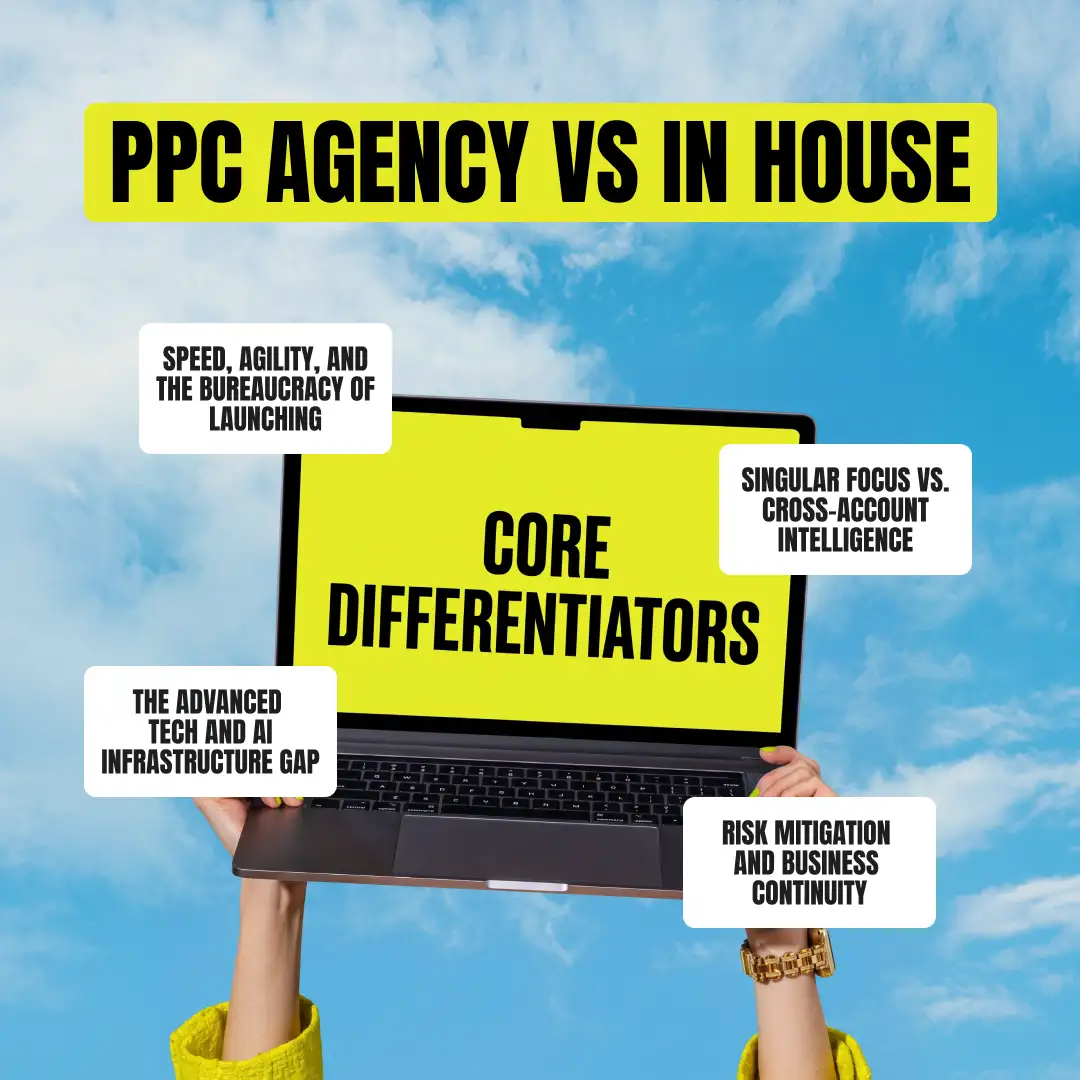
Singular Focus vs. Cross-Account Intelligence
In-House PPC teams give you 100% of their brainpower. An internal manager knows exactly what your profit margins are, they know your inventory levels, and they understand your customer lifetime value intimately.
If you go with an agency, you get the power of pattern recognition. A solid PPC Agency is managing millions of dollars across tons of industries. When conversion rates tank globally because of a weird Google algorithm update, they know it’s a platform issue, not a “you” issue. They also see what creative formats are crushing it in other industries and can instantly apply those learnings to your campaigns.
Speed, Agility, and the Bureaucracy of Launching
If a shipment gets delayed and a core product goes out of stock at 10 AM, an in-house PPC team can pause the ads by 10:05 AM. They pivot on a dime. Conversely, an agency is infinitely faster at scaling into net-new territory.
If you suddenly want to launch a massive Demand Gen campaign from scratch, an agency has the workflows, creative templates, and launch checklists ready to go. An internal team might need three weeks just to research how to set it up properly.
Risk Mitigation and Business Continuity
There is also the dreaded “Bus Factor.” If your sole in-house Google Ads manager ghosts you or takes another job, all that historical account knowledge walks right out the door with them. Your campaigns stall while you scramble to hire a replacement.
When you work with an agency, you have built-in continuity. If the account manager leaves, the agency’s internal data logs, systems, and backup strategists ensure your ads don’t skip a beat.
The Advanced Tech and AI Infrastructure Gap
Top-tier agencies spread the massive cost of enterprise software across all their clients. They also usually have direct lines to Google reps and get early beta access to new AI features before the general public gets to play with them.
The “Who Wins When” Matrix
| If your primary need is… | The Winner Is… | Why? |
| Pivoting messaging daily based on inventory | In-House | Direct access to warehouse/sales data without middleman delays. |
| Testing 50 new creative formats this month | Agency | Built-in design teams and asset generation workflows. |
| Keeping company data completely locked down | In-House | Zero third-party access to your CRM or audience lists. |
| Scaling spend rapidly without HR headaches | Agency | Instant access to a deep bench of buyers and analysts. |

Ready to Scale Without the Guesswork?
Stop burning cash on trial-and-error campaigns. Let our seasoned performance marketing team build a data-driven strategy that turns your ad spend into predictable, scalable revenue.
The Case for Building an In-House Team
Sometimes, bringing it in-house is just the right move. Here is when owning the process outright delivers the best ROI.
Deep Product Knowledge as Algorithm Fuel
AI needs context. An embedded employee can sit in on sales calls, understand the nuances of a highly technical B2B product, and map out exactly how offline conversion data feeds back into the ad account. They translate your company’s actual business goals into the value-based bidding signals that train Google’s AI to find your perfect customer.
Data Privacy, IP Ownership, and Direct Control
If you are incredibly protective of your first-party data, in-house is the way to go. You maintain absolute ownership over every custom audience list, every specific AI prompt, and the entire historical architecture of your account.
When It Makes Sense (The Thresholds)
You should start headhunting for internal Google Ads Experts when you have a highly complex, niche B2B sales cycle, your ad spend is reliably north of $150k-$200k a month, or if digital acquisition is literally your company’s core proprietary advantage.
The Case for PPC Outsourcing to a Google Ads Agency
For a lot of brands, renting the infrastructure makes way more sense than trying to build it from scratch.
Asset Generation and Rapid Testing at Scale
Modern campaign types like PMax are absolute monsters when it comes to consuming creative assets. They need constant fresh videos, headlines, and graphics to test. A reputable Google Ads agency brings a whole squad of copywriters and designers to the table. They can pump out ad variations and test them relentlessly without bottlenecking your internal design team.
Scalability Without Hiring Constraints
Want to double your ad spend next quarter? If you’re in-house, you might need to hire two more people, deal with HR, and figure out payroll. If you’re with an agency, you just send an email. You can scale up, scale down, or tap into specific talents (like a conversion rate optimization specialist) instantly.
When It Makes Sense (The Thresholds)
Partner with a Google Ads Company when you are in a phase of rapid growth, scaling from $15k up to $150k a month, or when your internal marketing team is already spread way too thin trying to manage SEO, email, and social media all at once.
The Hybrid Model: The Pragmatic Middle Ground
Don’t want to choose? You don’t necessarily have to. A lot of smart companies are adopting a hybrid model that merges internal context with external execution.
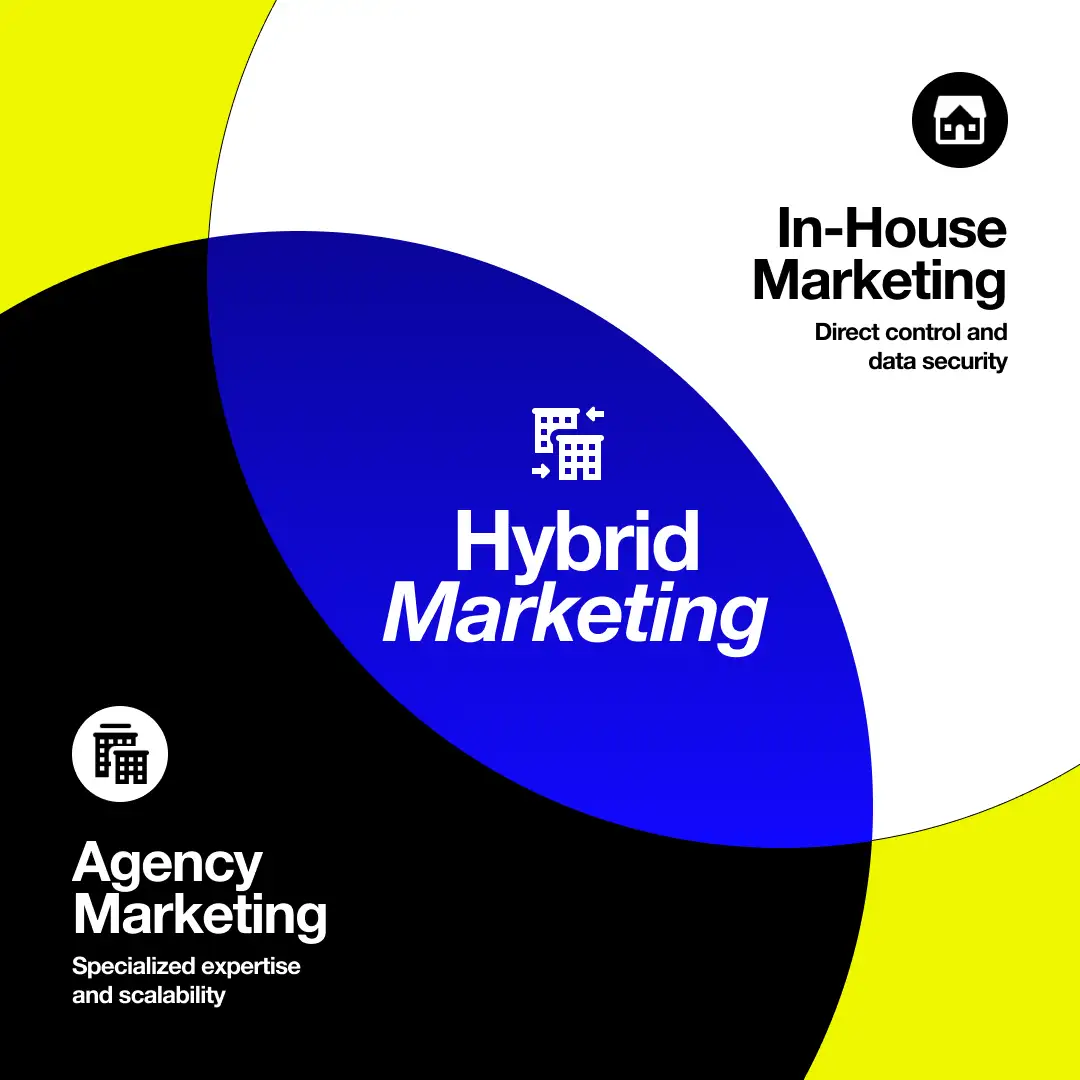
Internal Strategy + External Execution
In this setup, your internal Marketing Director holds the keys. They dictate the overarching business goals, set the strict budgets, and control the brand voice. The agency acts as the engine room—handling the technical execution, maintaining platform hygiene, and managing the AI bidding scripts. You steer the ship, they row.
Core Coverage vs. Specialized Channels
Another great hybrid tactic is splitting the channels. You keep your standard, branded Search campaigns in-house because they are predictable and stable. But you outsource the highly complex, visual, or AI-heavy formats (like YouTube ads or PMax) to the agency that has the creative bandwidth to feed them.
How to Manage the Hybrid Setup Successfully
- Set Ruthless KPIs: Don’t just ask for “more leads.” Define your target Cost Per Acquisition (CPA) or Return on Ad Spend (ROAS) clearly.
- Lock Down the Communication Cadence: Mandate a weekly 15-minute sync and a deep-dive monthly review. No more, no less.
- Keep CRM Data Clean: The agency can only optimize based on the data you pass back. If your internal team isn’t updating lead statuses in the CRM, the hybrid model falls apart.
How To Choose A Google Ads Agency: 5 Strategic Questions To Finalize Your Choice
Still on the fence? Grab a coffee, sit down with your leadership team, and answer these five questions honestly:
- What is our true monthly ad spend projection for the next 12 months? (If it’s under $50k, lean agency. If it’s over $150k, start looking in-house).
- Do we actually have the internal bandwidth to manage an external vendor? (Outsourcing still requires oversight; you can’t just set it and forget it).
- How complex is our conversion tracking and CRM integration? (If it requires custom coding and API connections, you likely need agency-level tech chops).
- How quickly do we need to see scalable results? (If you need traction yesterday, agencies launch faster).
- What is our risk tolerance for employee turnover? (If losing a key marketing employee would severely damage your revenue, the continuity of an agency is a massive safety net).
Where Appinventiv Digital Fits Into Your Growth Stack
If you’re leaning towards outsourcing but are terrified of getting handed off to a junior account manager who doesn’t understand your business model, that’s exactly where Appinventiv Digital steps in. We built our model to bridge the gap between internal control and external firepower.
We don’t just launch campaigns and ghost you until the end-of-month report. We act as a true, embedded extension of your marketing department, delivering 360-degree Google Ads Management Services.
That means we handle the entire ecosystem—from strategizing complex search architectures and tightening up your CRM data pipelines, to designing the relentless stream of creative assets needed to feed hungry AI algorithms like Performance Max.
Our bench of Google Ads Experts gives you the deep, nuanced understanding you’d expect from a senior in-house hire, but backed by the enterprise tools, cross-industry intelligence, and scalability of a top-tier Google Ads Company. Whether you are looking to hand over the reins entirely or want a powerhouse partner for a hybrid setup, we make sure your ad dollars are actually translating into bottom-line revenue, completely stress-free.

Let’s Talk About Your Growth Goals
Still on the fence about your next move? Drop us a line, and let’s map out the most profitable path forward for your exact business model.
The Final Verdict
The choice between bringing Google Ads in-house or hiring an agency is a strategic business lever that should evolve as you grow. If you’re grinding through the scaling phase, lean on an agency’s established infrastructure to move fast without bloated overhead. But if you’re spending hundreds of thousands a month and need granular, protective control over your proprietary data, it’s time to build your own machine.
Whatever you choose, remember that the AI era of Google Ads heavily rewards high-quality data inputs and creative agility. Pick the model that best equips your brand to feed the algorithm, test relentlessly, and ultimately, drive revenue.