




FAQs
What does agentic search mean for SEO?
It means the end of optimizing purely for human clicks. You must now optimize for machine comprehension and task execution. Success is defined by whether an autonomous bot trusts your data enough to act on it for the user.
How do AI agents affect SEO?
They dramatically increase zero-click searches but skyrocket the conversion value of the traffic you do get. Instead of driving window shoppers, AI agents deliver highly qualified actions—often completing the research phase before hitting your site.
How do AI agents discover websites?
Beyond standard search indexes, agents look for machine-readable blueprints. They rely heavily on the accessibility tree, semantic HTML, and emerging standards like llms.txt or agents.md to understand what actions are available on your site.
How to appear in AI search results?
You need extreme "information gain." Regurgitating consensus content won't cut it. To earn citations, publish original research, unique expert insights, and structure your answers cleanly so the AI can pull the exact data point instantly.
The search journey you grew up with is basically collapsing. For decades, the transaction was simple: a user types a query, gets a list of blue links, clicks a few, and forms a conclusion. The human did the heavy lifting.
That playbook is fading fast. We are rapidly moving from users looking for answers to users delegating entire tasks to autonomous bots. It’s no longer about just showing up in a feed; it’s about ensuring that when a machine is dispatched to solve a problem, it chooses your data and executes on your site. If you want to maintain your edge, you need to understand the mechanics of agentic search.
Here is a deep dive into how to adapt your digital presence so you don’t get left behind in this new era.
The Shift from Manual Search to Agentic Action
To understand what’s happening, you have to draw a hard line between a smart answering machine and an autonomous assistant.
AI Search vs. Agentic Search: Defining the Difference
AI search (like what you see in standard AI Overviews) retrieves information, synthesizes it, and drops a summary at the top of the page. It’s a reading assistant.
Agentic search is an entirely different beast as it acts on the user’s behalf. If someone wants to book a flight, find the cheapest software subscription, or compare CRM features, they don’t click anymore. The human sets the goal and approves the final outcome, but the bot handles everything in between. It breaks a complex query into sub-tasks, browses live websites, evaluates options, and even clicks “add to cart” or submits forms.
The Impact of Conversational Queries and Zero-Click Environments
Because users are shifting to long, conversational queries (8+ words rather than 2-word keywords), search engines are keeping them on the main results page longer. Yes, zero-click searches are climbing.
But the kicker is, a zero-click result isn’t a total loss if you are the one being cited as the authoritative source. Earning that citation is the core of AI search visibility. If a user gets their answer without clicking, you still want your brand name attached to that answer.
The New Fundamentals of Visibility: GEO and AEO
Traditional optimization isn’t dead, but it needs an upgrade. This is where Answer Engine Optimization (AEO) and Generative Engine Optimization (GEO) take the wheel.
Answer Engine Optimization (AEO): Structuring for the Snippet
Bots absolutely hate fluff. If an LLM has to parse three paragraphs of backstory to find a specific feature list, it will bail and scrape a competitor’s site instead. AEO is about stripping away the fat. Put the core data, precise definitions, or pricing tiers right at the top of your modules. Make every single section capable of standing entirely on its own.
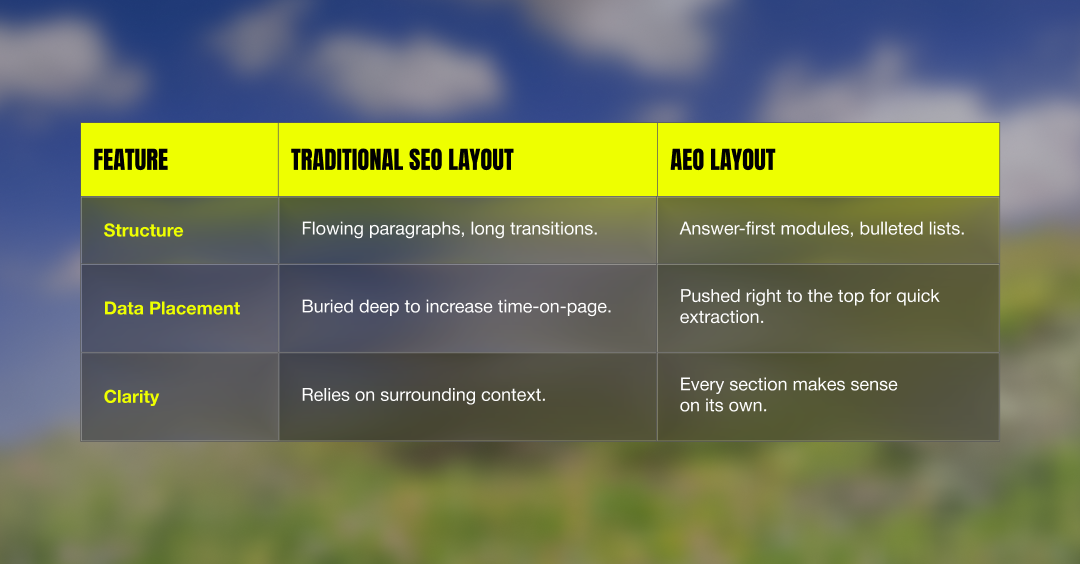
If your answers can’t stand alone, an AI engine will just skip to a competitor who makes it easier to parse.
Generative Engine Optimization (GEO): Building Entity Authority
Stop obsessing over keyword density on isolated pages. Visibility today is driven by how well an AI understands your brand as a connected entity. You want the machines to recognize you as a trusted node within a specific topic cluster. AI search optimization means feeding the ecosystem with clear definitions, structured data, and unambiguous signals about what you do and who you serve.

Stop Optimizing for Ghost Town Traffic. Evolve Your SEO
Let our experts build a strategy that bots actually respect.
Information Gain and E-E-A-T as Your Greatest Moat
The fact is that AI models actively skip consensus content. If your blog post just repeats what five other sites are saying, the bot has zero reason to cite you. The only way to win is through “information gain,” bringing original research, proprietary data, or unique expert quotes to the table.
Combine that with massive Experience, Expertise, Authoritativeness, and Trustworthiness (E-E-A-T), and you build a moat that AI bots love to pull from.
Technical SEO for AI Agents (The Action Layer)
Getting the content right is only half the battle. SEO for agentic search largely comes down to whether a machine can physically interact with your website.
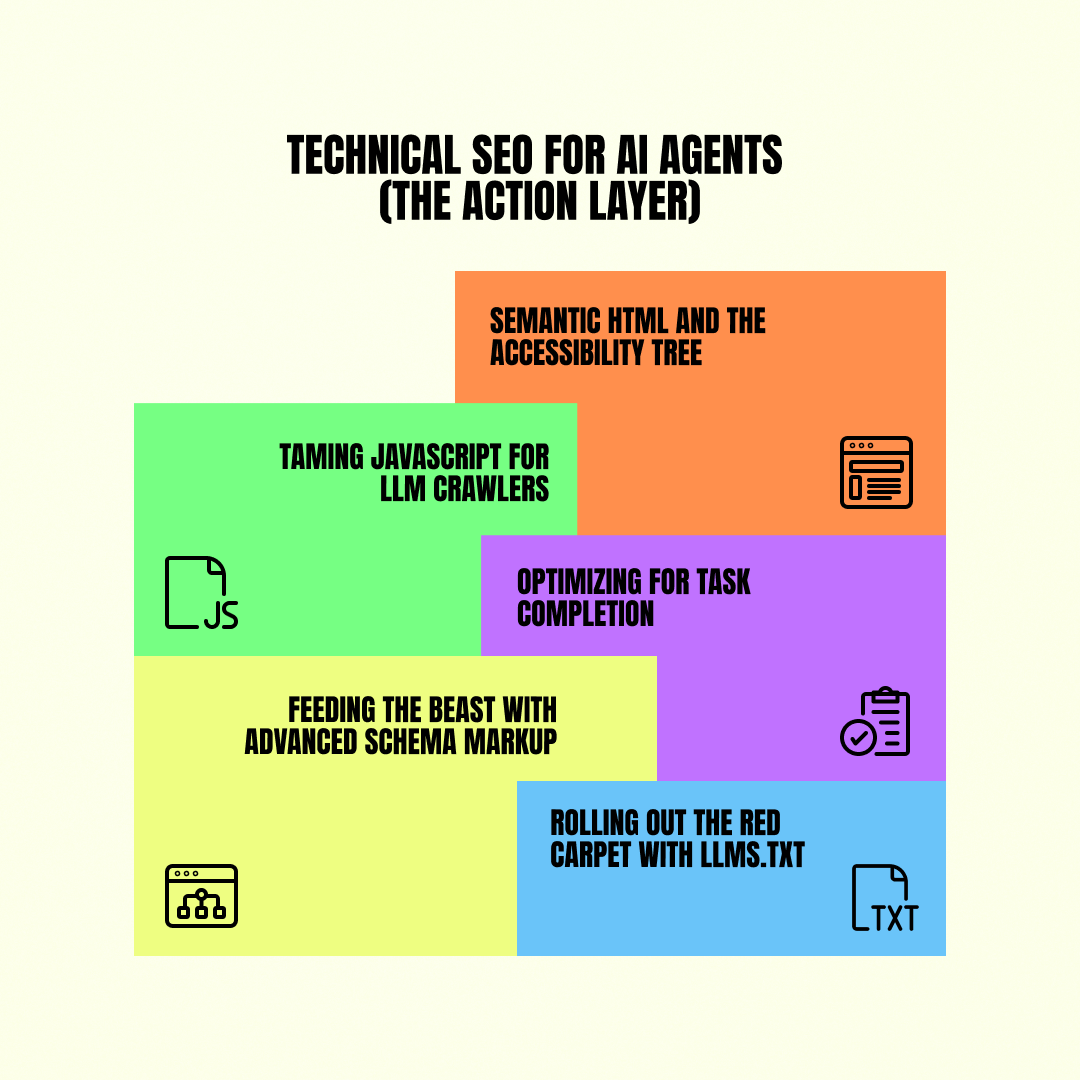
Semantic HTML and the Accessibility Tree
Web developers have known about the Accessibility Tree for years—it’s what screen readers use to describe a page to visually impaired users. Turns out, autonomous agents use this exact same tree to figure out what they can click.
If you build a slick, custom “Buy Now” button using generic <div> tags without semantic roles (like role=”button”), a human might know to click it, but an agent just sees dead text. It gets stuck. Clean, semantic HTML is no longer just a compliance checkbox; it is the absolute foundation of agentic search optimization.
Taming JavaScript for LLM Crawlers
Client-side rendering is a nightmare for AI bots. While some advanced crawlers can execute JavaScript, many will just look at your initial HTML payload. If your pricing table, product specs, or contact forms only load after a bunch of scripts fire, the bot sees an empty shell. Serving your core content server-side ensures the data gets retrieved immediately.
Optimizing for Task Completion
It is important to think about the conversion path too. When a machine tries to complete a form on your site, can it do so easily? Are the form fields clearly labeled? It is essential to optimize for machine-to-machine interactions. Remove unnecessary pop-ups, simplify navigation, and ensure your APIs or structured data clearly state what actions are available on the page.
Feeding the Beast with Advanced Schema Markup
You already know schema matters. But in the agentic world, it’s absolute table stakes. Bots don’t have the time or the reasoning skills to guess what your pricing table means. Wrapping your core business data in precise structured markup gives these autonomous agents a direct, foolproof map to your most important assets. If the data is ambiguous, the bot just moves on.
Rolling Out the Red Carpet with llms.txt
There is a new technical standard brewing, and it’s built entirely for bots. Just like you use a robots.txt file to guide traditional crawlers, creating an llms.txt or agents.md file tells these language models exactly where to find your most digestible, machine-ready data. Setting these files up early gives your site a massive first-mover advantage while everyone else is still debating basic meta tags.
SEO Strategies for Agentic Search to Win Citations and Influence LLMs
You want the language models to talk about you. But they don’t just learn from your website; they learn from everything else on the internet.
Earning “Preferred Source” Status and Brand Loyalty
Search platforms are increasingly rolling out personalization features where users can set “preferred sources.” If a user trusts your brand and visits often, the AI will prioritize your content in their generated answers. Building actual brand loyalty—through newsletters, direct traffic, and repeat visits—now carries a massive algorithmic payoff.
Leveraging Third-Party Validation and PR
If you want to know how agentic search is changing SEO, look at PR. Models weigh third-party validation heavily. Getting mentioned on industry podcasts, quoted in major publications, and discussed on authoritative forums trains the LLM that you are a big deal. These unlinked brand mentions are the new backlinks.
Expanding Conversational Coverage (The New FAQ)
To capture agentic traffic, build out content that answers the exact, conversational questions users are feeding into bots. Stop targeting broad terms and go after the specific questions. Cover the “why now” and “how much” questions directly and concisely.
Keeping Your Data Relentlessly Fresh
Language models are completely obsessed with recency. If your big industry report hasn’t been updated in two years, an agent evaluating current market trends will pass right over it for a fresher source. You have to build a continuous refresh cycle into your content calendar. Make sure your stats, pricing tiers, and product comparisons are completely up to date so the bots have no excuse to ignore you.
Optimizing Beyond Text for Multimodal AI
Search is no longer restricted to text files. The models driving these bots are actively pulling from videos, images, and audio to construct their answers. If you have a killer video tutorial explaining a complex workflow, ensure the transcript is clean, the timestamps are clear, and the metadata is perfectly tuned. You want these agents grabbing your visuals to back up their automated summaries.

Is Your Website Completely Invisible to Autonomous AI Agents?
Run a technical diagnostic to uncover what the bots see.
Measuring Success: The New KPIs for Agentic Search
You can’t manage what you don’t measure, but the old metrics are starting to crack.
Moving Beyond Clicks: The Brand Visibility Score
Measuring organic traffic alone won’t cut it anymore. If your content is feeding an AI summary, the user might never hit your URL, but your brand is still answering their question. We need to pivot to tracking share of voice within LLMs, overall citation rates, and sentiment as our primary success metrics.
| Legacy Metrics | AI-Era Metrics |
| Organic Traffic / Clicks | Brand Visibility Score (appearance in AI summaries) |
| SERP Ranking Position | Citation Rate / Share of Voice in LLMs |
| Bounce Rate | Agent Task Completion Rate |
Tracking Agentic Bots in Server Logs
One of the best SEO strategies for agentic search is simply knowing who is knocking on your door. Audit your server and CDN logs to identify agentic traffic. Make sure your firewall isn’t accidentally blocking them with 403 errors. If you block the bot, you block the visibility.

Ready to Dominate the Time of Zero-Click Search? Let’s Talk.
Send us a quick message to secure your digital footprint.
Future-Proofing Your Digital Presence
The shift toward agentic search isn’t some distant tech prediction—it is happening right now in your server logs. While your competitors are still sweating over keyword density and traditional ranking gaps, you have a massive window to pivot.
Start building content that real buyers trust and machines can actually execute on. If you prioritize deep, original research and lock down a pristine technical foundation, your brand won’t just survive the transition to zero-click environments. You will become the definitive entity that autonomous agents default to when they need to get a job done. Time to get your site ready for the bots doing the buying.