


FAQs
How much should I budget for PPC?
It depends on your CPA targets and industry competitiveness, but most campaigns need at least a two-week learning window before you can judge true performance. Starting too small to gather meaningful data is a common early mistake.
Is PPC still worth it with AI Overviews reducing organic clicks?
Yes; in fact, more so. As zero-click search grows, paid placements remain one of the few guaranteed ways to control visibility for high-intent queries.
How much control do I actually have over Performance Max campaigns?
You will have enough control. Though you can't bid on individual keywords, asset quality, audience signals, and negative keyword lists all still shape where your budget goes.
How is AI changing the way PPC campaigns actually get run?
AI handles most of the mechanical work, real-time bidding, budget shifts, ad variations, but it only optimizes toward what it's told to value. The strategy has shifted upstream: setting the right signals, structuring clean data, and catching when automation drifts toward the wrong outcome.
Should I use Smart Bidding immediately, or start manual?
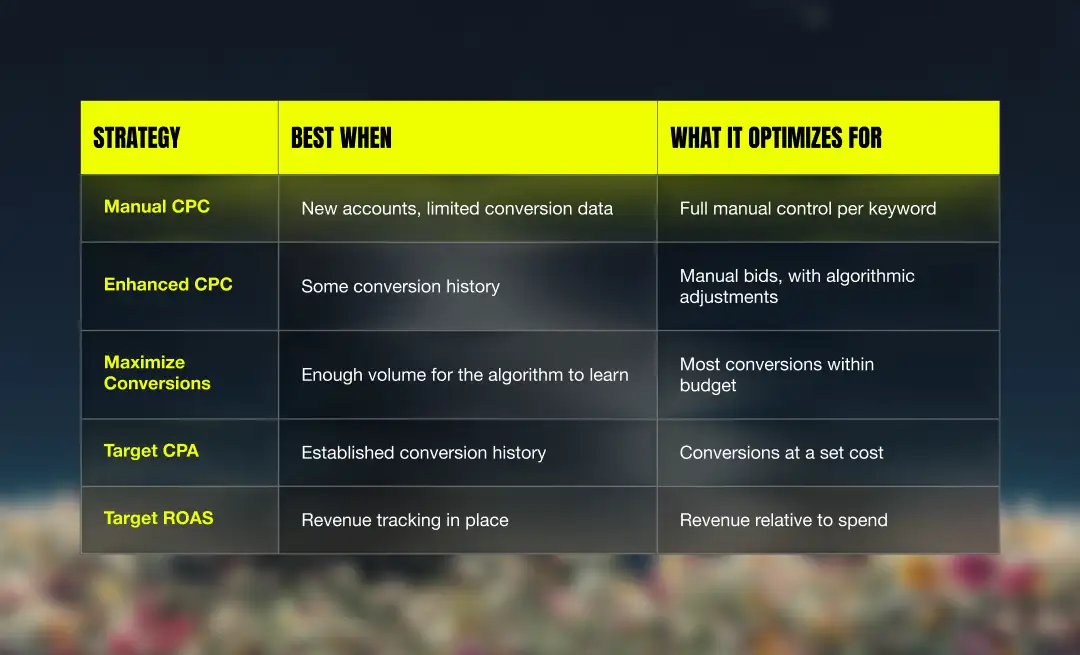
Start manual or Enhanced CPC until you have enough conversion volume (generally 15-30 conversions in 30 days) for Smart Bidding's machine learning to have enough data to work with. Automating too early with thin data tends to backfire.
What's a good CTR for Search ads?
It varies heavily by industry, but the number itself matters less than the trend; a CTR consistently below your account average on a keyword is a signal worth investigating, not a fixed benchmark to hit. It's also worth checking whether AI Overviews are appearing on that query; they can suppress CTR across the board regardless of how strong your ad is.
You are probably losing most of your money on Google Ads, without even realising it. Not because your targeting is off, but because you are still running paid search like it’s 2019. You’re likely spending more time than you need to on manually adjusting bids, guessing at audiences, and treating every campaign the same way. Meanwhile, the auction itself has seen a foundational change.
Based on our experience in the market, we have drafted a complete PPC guide that will help you close this gap between how PPC actually works today and how most teams still run it. We will cover the fundamentals that will never get outdated and walk through the parts that have genuinely shifted.
PPC Advertising | A Quick Overview
PPC, or pay-per-click, is an advertising model where you buy placement instead of earning it. So, you basically bid for a spot and pay only when someone clicks, and the moment you stop paying, the visibility stops too.
Where does PPC actually live?
PPC covers more ground than most of us know. It’s not just about Google Ads; here’s all that PPC covers-
- Search ads: bidding on keywords so your listing appears above organic results.
- Paid social: Meta, LinkedIn, TikTok, X ad placements targeted by audience rather than keyword intent.
- Display & Programmatic: banner and video placements bought across ad networks, usually for awareness rather than direct response
- Shopping and marketplace ads: product listings on Google Shopping, Amazon, and retail media networks
PPC vs. SEO | Where It Fits in Your Marketing Mix
PPC and SEO work on different clocks. While Search Engine Optimization compounds over months and eventually stops costing you per click, PPC starts producing traffic the day you launch and immediately stops the day you turn it off.
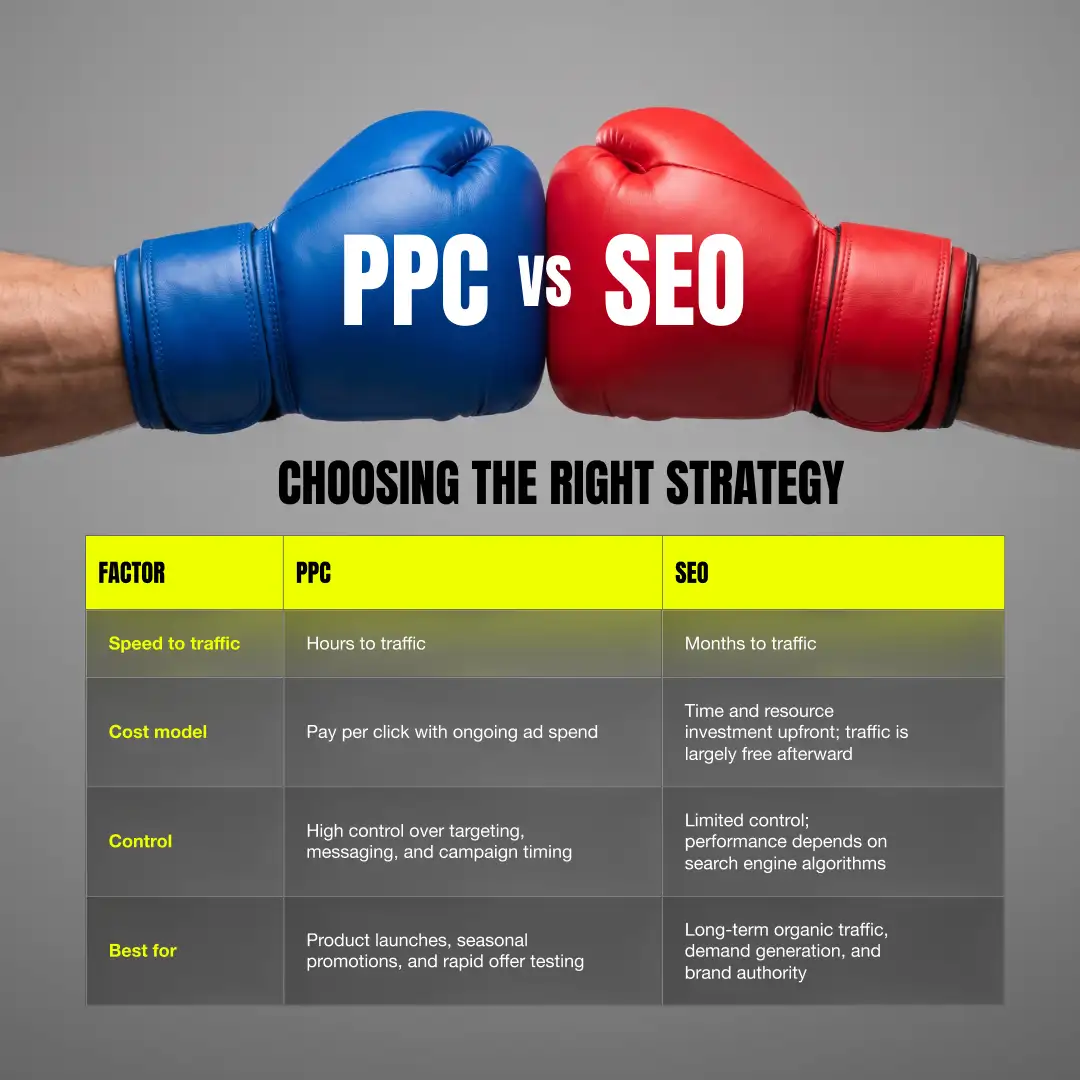
You do not have to pick one for your marketing plan and stick to it. Rather, spend time carefully understanding which of the two will perform the best at any given time. So, this comparison table showed how these 2 are different; here’s how you decide which one fits for what job.
Match the channel to the funnel stage, not the other way around-
- Top of funnel
This is where paid social and display PPC tend to do the most of the grunt work. You’re creating demand with someone who wasn’t looking for you yet. SEO can play here too, through broad informational content, but it’s slower to build the audience volume that paid can generate on day one.
- Middle of funnel
This is SEO’s strongest ground: comparison content, buyer’s guides, “X vs. Y” pages that show up when someone is actively evaluating options. And increasingly, that same content is what LLMs pull from when answering comparison queries directly, so it’s doing double duty as an AI citation source. Search PPC can also compete here, bidding on the same comparison-intent keywords, usually to defend against a competitor doing the same.
- Bottom of funnel
Search PPC is built for this, bidding on high-intent, near-transactional keywords (“buy,” “pricing,” “near me”) where the cost per click is highest but so is the conversion probability. SEO owns this too if a brand has invested enough to rank organically for those same terms, at a fraction of the ongoing cost.
A few examples,
| Scenario | Better Fit | Why |
| Launching a new product next month | PPC | No time to wait for organic rankings to mature |
| Building long-term category authority | SEO | Compounds over time, doesn’t stop when spend stops |
| Defending your brand name from competitor bidding | PPC | Blocks competitors from outranking you on your own terms in paid results |
| Answering “X vs. Y” comparison searches | SEO (with PPC backup) | Comparison content ranks well organically; PPC can defend the same keywords |
| Seasonal or time-boxed campaign (holiday sale, event) | PPC | Immediate visibility for a fixed window, no long-term equity needed |
| Ranking for high-intent buy or pricing keywords | Both | PPC wins the click today; SEO reduces cost-per-click dependency long-term |
| Limited budget, long runway before ROI is expected | SEO | Lower ongoing cost once rankings are established |
| Testing a new audience segment or message before committing budget | PPC | Fast, structured performance data to validate before scaling |
| Established brand maintaining market share | Both | PPC handles defense and new-audience testing; SEO carries sustained volume |
| Startup needing quick traction with limited runway | PPC | Speed matters more than compounding equity at this stage |

Want Every Ad Dollar to Earn Its Way Back?
Leverage strategies that drove a 62% ROAS lift for American Express and a 4.8x average ROAS across managed campaigns.
Why PPC Matters for Your Business
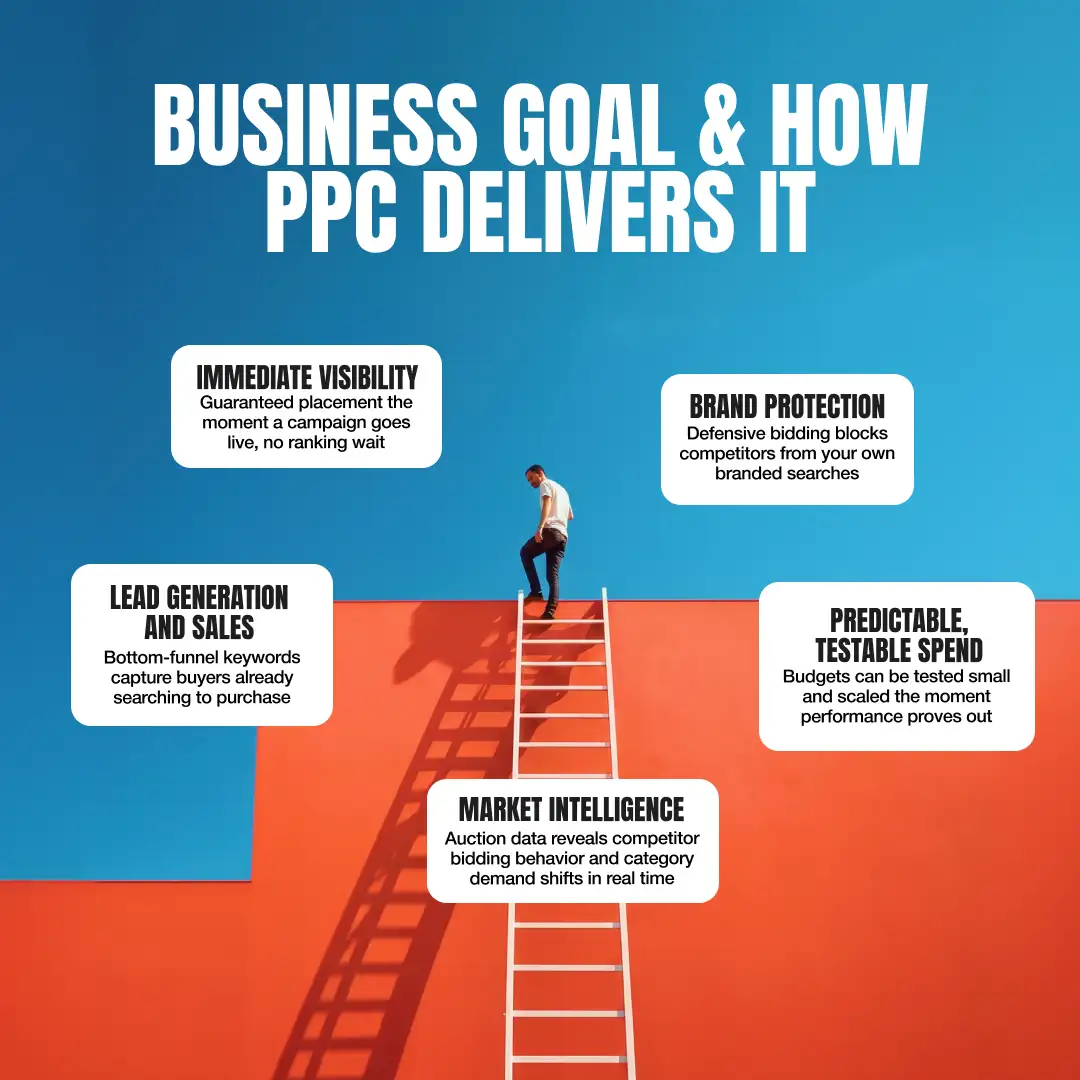
PPC isn’t a line item you run because competitors are running it. It’s one of the only marketing channels where visibility is guaranteed the moment you’re willing to pay for it, no algorithm to win over, no months of compounding required.
- Immediate, Controllable Visibility
Organic rankings take months to build and can shift with a single algorithm update you didn’t see coming. PPC sidesteps that entirely: bid, launch, and you’re visible on page one within hours, for exactly the terms you choose.
- Precision at the Point of Intent
Unlike most channels, PPC lets you show up at the exact moment someone is deciding, not just discovering. A search ad on “buy X” isn’t competing for attention; it’s answering a question someone already typed.
- Budget That Scales With Certainty
Every dollar in PPC is trackable back to a click, a conversion, and increasingly, a revenue number. This level of attribution allows marketing leaders to back budgets by data rather than guesswork or intuition.
- Defending Ground SEO Can’t Cover Alone
Ranking #1 organically for your brand name doesn’t stop a competitor from bidding on it. PPC is often the only lever that closes that gap. It protects the traffic you’ve already earned the hard way.
- Visibility as Zero-Click Search Grows
As AI Overviews and answer engines absorb more organic clicks, paid placements are becoming one of the last guaranteed ways to reach a high-intent searcher at all. Zero-click search isn’t slowing down, and PPC is one of the few channels built to survive it.

See Where Your Ad Spend is Actually Going
We'll run a free audit across your campaigns and measure every channel against a live ROAS target, not a monthly report card, so you know exactly what to fund and what to cut.
Major PPC Platforms for Businesses
Quick Summary
| Platform | Strongest For | Weakest For |
| Google Ads | Capturing active search intent | High cost-per-click in competitive niches |
| Microsoft Ads | Lower-cost B2B and enterprise reach | Limited overall traffic volume |
| Meta | Precision audience targeting, awareness | Long sales-cycle, high-ticket conversion |
| YouTube | Brand recall at scale, affordable impressions | Direct-response conversion |
Not all PPC platforms serve the same purpose. Here are the main platforms to consider for your campaign:
-
Google Ads
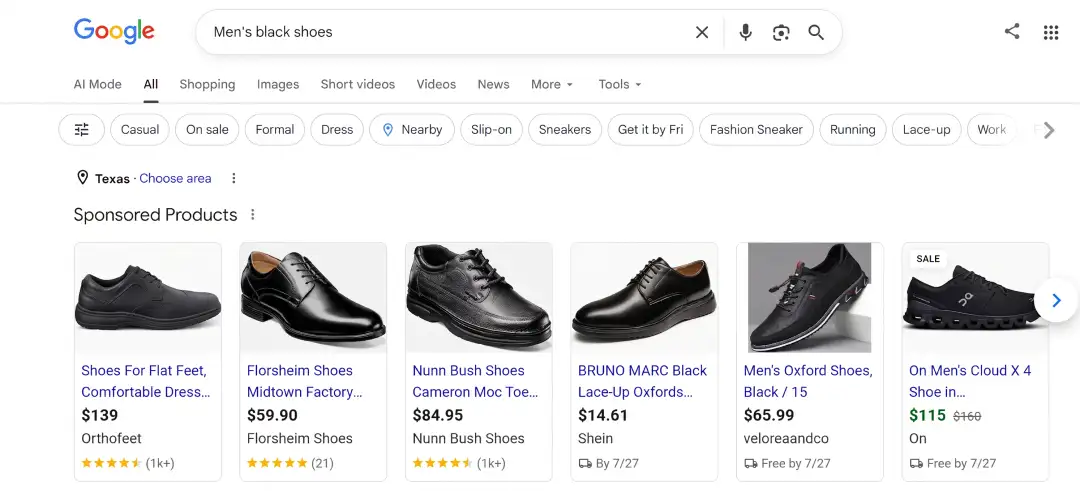
This is still the default point for PPC strategies for beginners as well as experienced marketers. It captures active intent; someone has already typed the problem or a product into a search bar. It’s the highest intent, and usually the most expensive platform available.
It also extends well beyond just text ads with its Shopping and Performance Max format. This is the reason why it tends to have the largest single share of a paid budget in most mixes.
-
Microsoft Ads
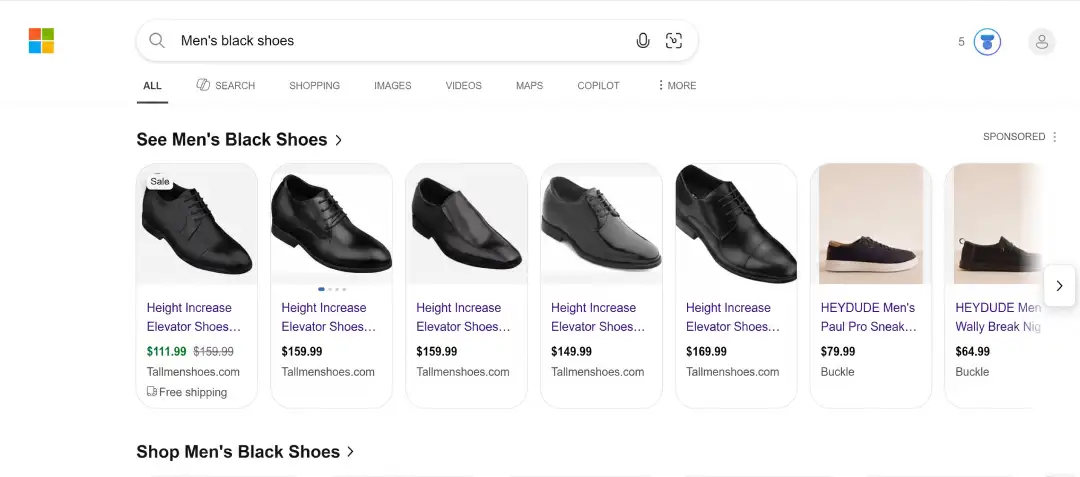
This one is consistently underused, mostly because of Bing’s smaller search share. But what most advertisers miss is that with a smaller search share comes lower cost-per-click and less auction competition, since fewer buyers tend to build here.
It also leans toward an older, higher-income demographic (Bing ships as the default on a lot of enterprise and government machines). This makes it disproportionately effective for B2B and higher-ticket offers relative to its size.
- Meta (Facebook/Instagram)
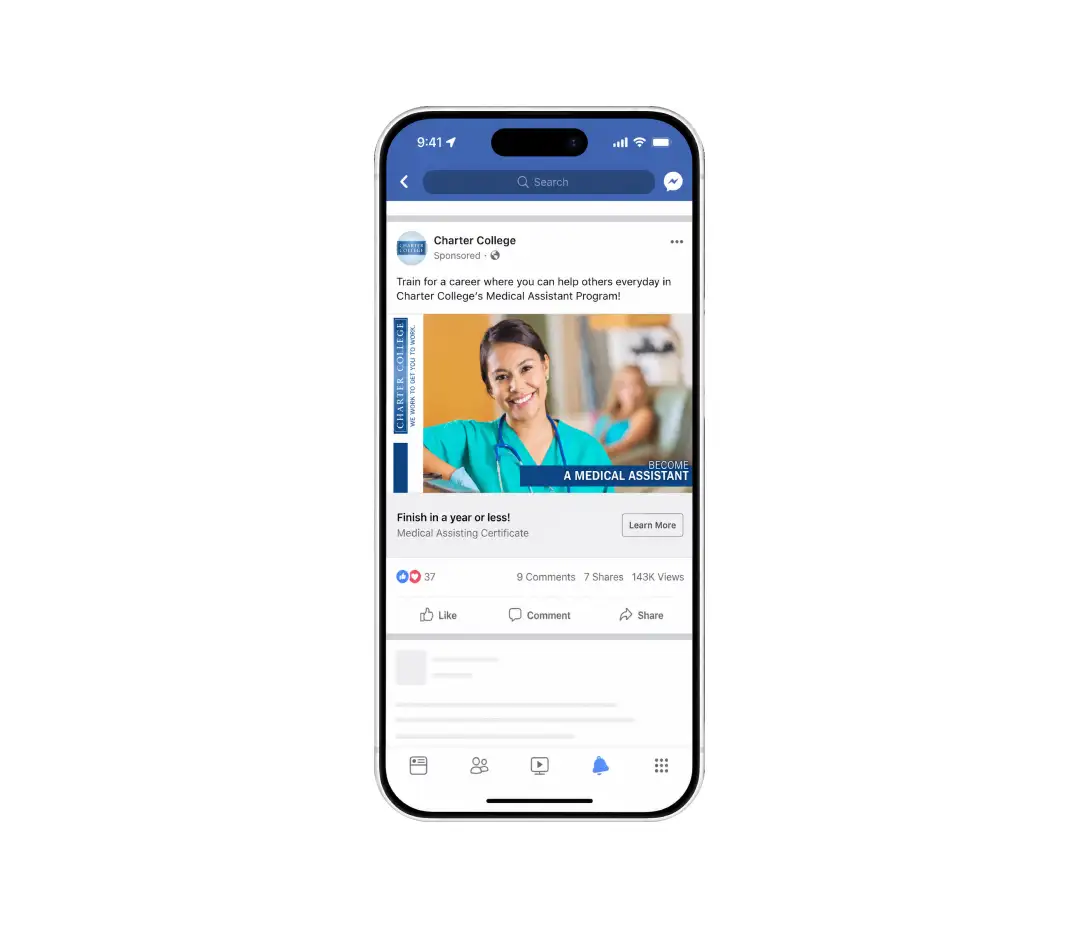
Facebook or Instagram ads interrupt, rather than capturing intent. You’re targeting based on behavior and interest, not an active search. Strongest for demand generation, retargeting, and visually-driven products. It is best used to build demand before someone starts searching, especially for visually-driven, B2C products.
- YouTube
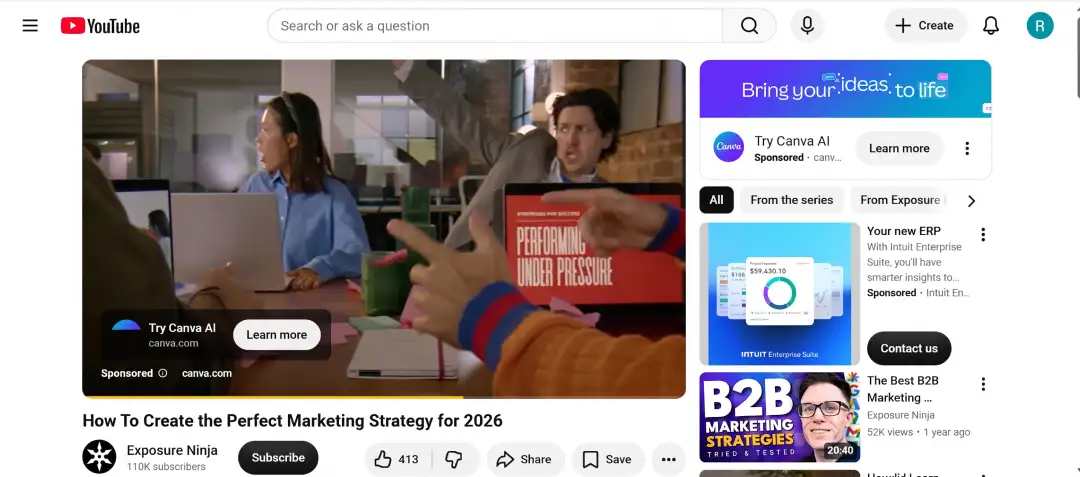
It sits inside the Google Ads platform but functions differently; you’re buying attention during video consumption, not a search result. Skippable in-stream and Shorts placements make it viable for both brand awareness and, increasingly, direct response. This is best-suited for products that benefit from demonstration or storytelling.
Understanding the Cost of PPC
PPC cost has two separate components that get conflated constantly: ad spend (what you pay the platform) and management fees (what you pay a person or agency to run it well). Budgeting for one without the other is how most first-time PPC budgets come in short.
-
Cost by Service Model
| Service Model | Typical Monthly Cost | What’s Included |
| DIY / Self-Managed | Ad spend only, plus tool costs ($100–$400/mo) | You own strategy, execution, and optimization directly |
| Freelancer | $1,000 – $3,000/mo (excludes ad spend) | Single-person management, limited specialization depth |
| Agency: Flat Fee | $1,500 – $10,000/mo (excludes ad spend) | Strategy, campaign build, ongoing optimization, reporting |
| Agency: % of Ad Spend | 10–20% of monthly spend, often with a minimum fee | Scales with budget; typically includes tracking, testing, and reporting |
| Full-Service (Multi-Platform) | $5,000 – $25,000+/mo | Search + social + shopping management, creative, attribution modeling |
-
Cost by Company Size
| Company Size | Typical Monthly Ad Spend | What It Usually Buys |
| Startup / Small Business | $1,000 – $5,000 | 1–2 campaign types, single platform, limited testing |
| Mid-Market | $5,000 – $20,000 | Multi-platform presence, structured Smart Bidding, regular optimization |
| Enterprise | $20,000 – $100,000+ | Full-funnel campaigns across platforms, dedicated attribution modeling, creator/creative production |
-
What Actually Drives the Number
A handful of variables move PPC cost more than company size alone:
- Industry competitiveness: legal, finance, and home services routinely see some of the highest CPCs in any market, simply because more advertisers are bidding for the same intent
- Platform mix: Search and LinkedIn CPCs run meaningfully higher than Meta or Display, reflecting the intent gap between the two
- Account complexity: more products, more locations, more languages all multiply the management effort behind the same ad spend
Expert Tip: Don’t evaluate a management fee against ad spend in isolation; evaluate it as a percentage of total budget. A $2,000 fee on a $5,000 budget is a very different decision than the same fee on a $30,000 one.
Different Types of PPC Campaigns
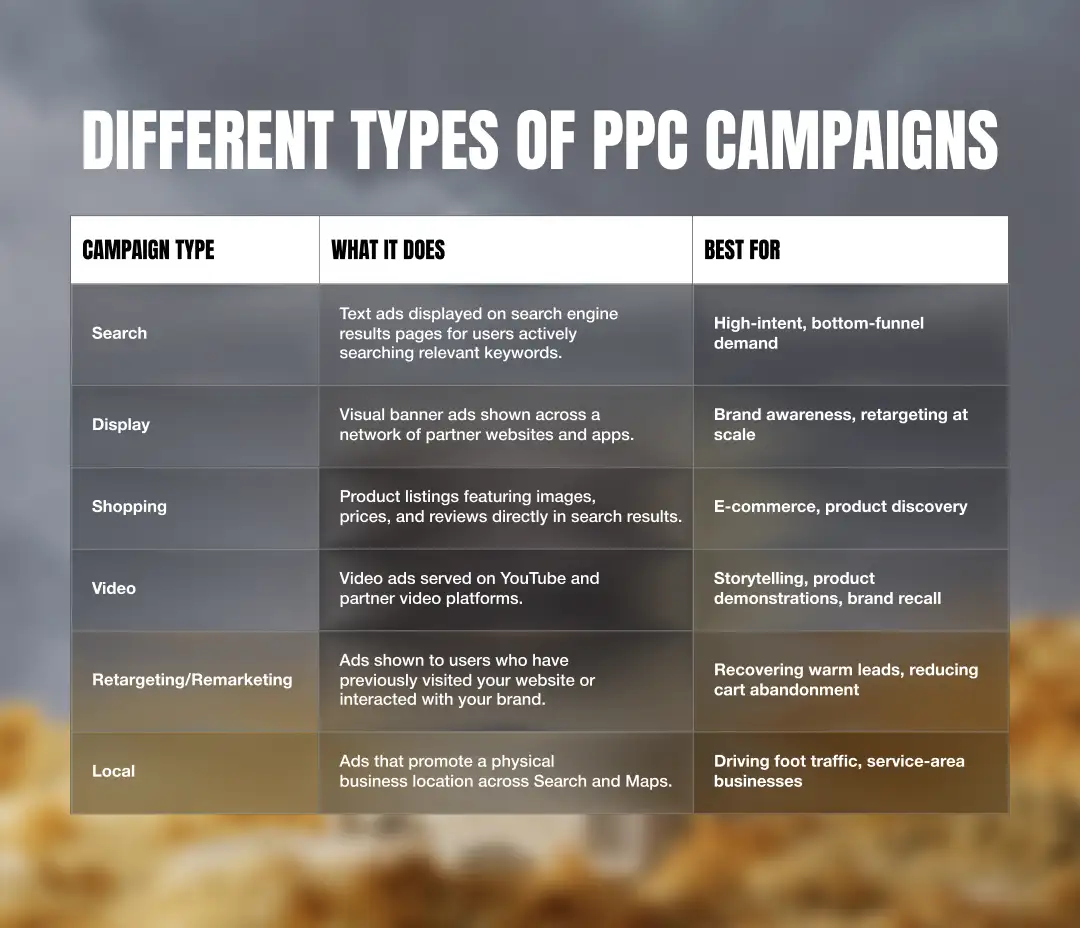
PPC platforms are one axis and campaign types are the other. Within any single platform, the type you choose changes what the campaign is actually built to do.
- Search Campaigns
Shown above or alongside organic results, these text ads are triggered by keyword bids. These are built for capturing existing intent, which makes it the highest-converting format and the most competitive on cost.
AI in marketing now runs most of the bidding decisions here in real time, but the keyword strategy and ad relevance still have to be built by a person first.
- Display Campaigns
Banner ads placed across partner sites rather than search results, lower cost, lower intent, since the audience is browsing something else entirely. Earns its place for retargeting and top-of-funnel awareness, not immediate conversions.
- Shopping Campaigns
Product ads pulled straight from a merchant feed: image, price, and title, no traditional ad copy. Most AI marketing agencies can help you do the heavy lifting on feed optimization and bid adjustments here.
- Video Campaigns
Primarily YouTube-driven, running as skippable in-stream, non-skippable, or short-form placements. Strong for storytelling and recall at scale, weaker for direct conversion, since watching a video is a lower-commitment action than a search already in motion.
- Social/Paid Social Campaigns
Native to Meta, LinkedIn, TikTok, and X, built around audience and interest targeting instead of keyword intent. Layered demographic and lookalike data lets a brand manufacture demand with someone who wasn’t actively looking. Best suited to awareness and consideration, not last-click conversion.
- Remarketing/Retargeting Campaigns
Re-engages people who already visited without converting. Typically the highest-ROI type in a mix, since the intent’s already there; the job is just to close the loop. Runs across Display, Meta, and YouTube, often stitched into one sequence.
- Performance Max (Google)
Google’s fully automated campaign type, running across Search, Display, YouTube, Gmail, and Shopping from one campaign. This is the clearest example of AI making the channel-mix decision in real time instead of a person splitting budget manually.
- App Campaigns
Drives app installs or in-app actions across Google’s full network from a single automated campaign, optimized around install volume or a specific in-app event rather than a webpage click.
- Local Campaigns
Drives foot traffic and local actions, store visits, calls, directions, pulling from Google Business Profile data across Search, Maps, and Display. The right fit for any brand with a physical location, converting nearby searchers into walk-ins.
- OpenAI Ads (ChatGPT) Campaigns
These are sponsored placements served inside ChatGPT conversations, matched to what a user is actively discussing rather than a keyword they typed. It is still an early, fast-changing platform, but worth watching for brands that want a foothold as research and decision-making shift from search into chat.
Building a PPC Campaign, Step by Step
This is the execution layer, the actual sequence you or your team should be running every time a new campaign goes live. If you skip a step here, your platform’s automation might optimize toward the wrong outcome.
-
Keyword Research & Intent
Start with intent, not volume. A keyword pulling 10,000 searches a month means nothing if most of that traffic is researching, not buying; you’ll pay to educate people who were never going to convert this cycle. AI keyword tools can speed up discovery, but sorting into intent is still a judgment call, so before a single ad gets written, every keyword needs to be sorted into one of three intent buckets:
- Informational (what is X): not for Search campaigns; route these to content instead
- Commercial investigation (best X for Y): mid-funnel, comparison-stage, where buyers are actively narrowing options
- Transactional (buy X, X pricing): highest intent, highest CPC, and where budget priority should sit
Expert Tip: The decision filter should always be intent match, not raw search volume; a smaller, transactional keyword list will consistently outperform a large, ambiguous one.
-
Audience Targeting & Segmentation
Keywords tell you what someone’s looking for and audiences tell you who they are. The strongest accounts layer both instead of leaning on one:
- In-market audiences: people actively researching your category right now
- Custom segments: built from your own URLs, competitor sites, or specific search terms
- Remarketing lists: site visitors segmented by depth of engagement (browsed vs. added to cart vs. abandoned checkout)
- Customer match: your CRM or email list, uploaded directly to target or exclude
You must focus on segmenting aggressively. For instance, do not treat a visitor who abandoned checkout yesterday and a cold prospect who’s never heard of your brand identically. They are two different buyers at two different stages!
-
Ad Copywriting
Ad copy has one job: prove relevance in the two seconds before someone clicks or scrolls past. That window isn’t shrinking; it’s already gone if the headline doesn’t match the search.
- Mirror the searcher’s exact language in your headline; this directly feeds Ad Relevance, one of the three Quality Score components
- Lead with the specific outcome, not the feature
- Use every available ad asset: sitelinks, callouts, structured snippets, since Google’s ad rank formula rewards ads that occupy more of the available real estate
- Write to the intent bucket the keyword falls into: a commercial-investigation keyword needs a comparison angle, a transactional keyword needs a direct offer
- AI copy generators can produce headline and asset variations fast for Responsive Search Ads, but every line still needs a human pass to confirm it matches the searcher, not just sounds plausible
-
Landing Page Alignment
The single most under-invested part of most PPC accounts, and one of the most expensive to get wrong. Your landing page has to deliver exactly what the ad promised:
- Same offer
- Same language
- Same next step
Every mismatch here is a paid click walking straight back out the door. Getting this right comes down to a few core fixes:
- Match the page headline to the ad headline word-for-word where possible
- One clear call-to-action per page, not five competing options fighting for the same click you already paid for
- Page speed isn’t a technical nice-to-have: conversion rates drop by roughly 7% for every additional second of load time. Slow pages also drag down Landing Page Experience, one of the three direct inputs to Quality Score
- Strip navigation and distractions from dedicated campaign landing pages; every exit link is a leak you’re funding
-
Bidding & Budget Setup
Choose a bidding strategy based on how much conversion data you actually have, not how much control you’d like to keep. Automating before the algorithm has enough signal to learn from is one of the most common ways accounts underperform in month one.
Common PPC Mistakes to Avoid
Most underperforming accounts aren’t broken in one big way; they’re leaking budget through a handful of small, repeatable habits. Here’s what shows up most often, and why each one costs more than it looks like on the surface.
- Chasing CPC instead of CPA/ROAS
An easy click that never converts is more expensive than an expensive click that does. It’s tempting to optimize toward the easiest number to lower, rather than the one that actually reflects business outcome. This is the single most common way accounts look healthy on a dashboard while quietly losing money.
- Constantly editing campaigns during the learning phase
Every significant edit, bid strategy, budget, ad copy, or targeting, resets the algorithm’s data collection. If you’re touching a campaign every few days during its learning window, you’re not speeding up optimization; you’re just repeatedly kicking the process back to day one. That’s the real reason so many accounts never seem to stabilize.
- Sending all traffic to the homepage
A homepage is built to serve everyone, which means it’s built to convert no one in particular. It kills Landing Page Experience and conversion rate together, and it’s one of the fastest ways to pay premium CPCs for a click that lands nowhere close to the offer that earned it.
- Ignoring negative keywords
Every irrelevant search term your ad shows up for is budget leaving the account with zero chance of converting. Left unmanaged, this is a slow, invisible drain; no single wasted click looks alarming, but the monthly total often does.
- Turning on Smart Bidding with bad conversion data
The system optimizes toward whatever you tell it matters, including the wrong thing. Feed it junk conversions, form spam, accidental clicks, a “thank you” page that also loads on refresh, and it will spend real budget getting you more of exactly that.
- Treating Quality Score as vanity
Quality Score isn’t just a number to feel good about; it changes what you actually pay. Two advertisers can bid on the exact same keyword with the exact same budget and end up with very different CPCs, purely because of Quality Score. Ignore it long enough, and you’re paying more than a competitor for the same traffic, without ever noticing why.
- No segmentation between new and returning visitors
One bid, one ad, one message for two completely different buying stages. A returning visitor who abandoned checkout yesterday and a cold prospect seeing your brand for the first time have almost nothing in common. Spricing them the same guarantees you’re either overpaying for the easy conversion or underbidding for the one still on the fence.
- Skipping a proper account structure
Cramming unrelated products or services into one ad group might save setup time, but it flattens Ad Relevance for every keyword in it. A tightly themed structure- one ad group, one intent, one message- takes longer to build and consistently earns lower CPCs in return.
Here are quick solutions to rectify the above problems-
| Mistake | Solution |
| Chasing CPC instead of CPA/ROAS | Set CPA or ROAS as the primary success metric before launch, and report on it first; CPC becomes a diagnostic number, not the goal. |
| Constantly editing campaigns during the learning phase | Lock major changes (bids, budget, targeting, copy) for the first two weeks; batch necessary fixes into one edit instead of several. |
| Sending all traffic to the homepage | Build a dedicated landing page per campaign that mirrors the ad’s exact offer and headline. |
| Ignoring negative keywords | Review the search terms report weekly and add irrelevant queries to a running negative keyword list. |
| Turning on Smart Bidding with bad conversion data | Audit conversion actions before automating, confirm each one reflects a real, valuable action, not a page load or accidental click. |
| Treating Quality Score as vanity | Track Quality Score alongside CPC monthly; treat a drop as a signal to fix relevance or landing page experience, not background noise. |
| No segmentation between new and returning visitors | Split campaigns or ad groups by funnel stage, with separate bids and messaging for warm vs. cold audiences. |
| Skipping a proper account structure | Rebuild ad groups around single, tightly themed intents, one product or service per group, not a mixed bucket. |
Expert Tip: Run a monthly audit specifically for search-term waste, mid-flight edits, and Quality Score drift; by the time CPA visibly creeps up, the leak has usually been running for weeks.
In-House vs. Agency for PPC | The Better Fit?
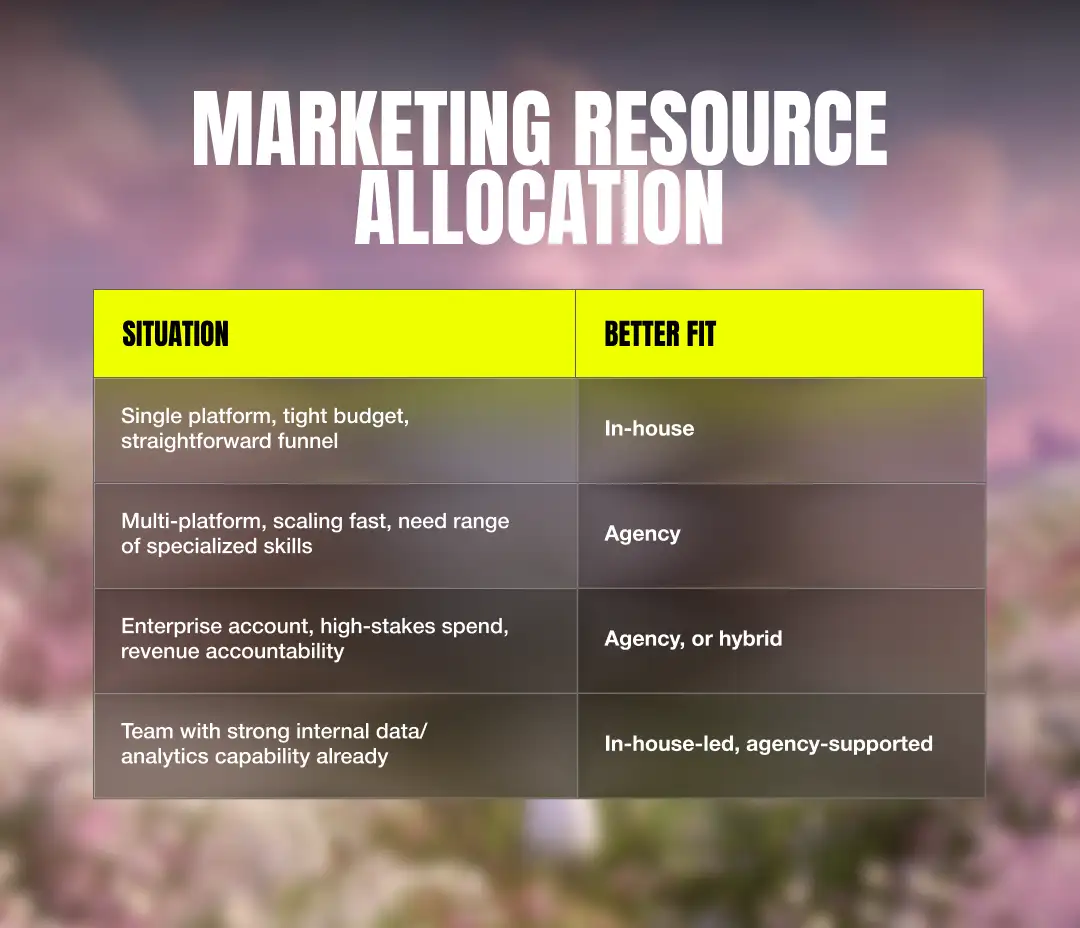
There’s no universal right answer here; the right setup depends on account complexity, how fast you need to move, and how much of this work your team can realistically own alongside everything else on their plate.
- What an In-House Team Gets You
- Direct product and brand context that doesn’t need to be briefed externally
- Faster internal approvals, no handoff delay on creative or budget decisions
- Full visibility into every lever, with no reporting layer between you and the account
The tradeoff: PPC now spans keyword strategy, bidding automation, creative, landing pages, and attribution, a genuinely wide skill set for one or two people to cover well, especially once an account runs across more than one platform.
- What an Agency Gets You
- A specialist bench, strategists, analysts, and creative resources sized to the account, not to headcount
- Cross-account pattern recognition, insight into what’s working across dozens of accounts in your category, not just your own data
- Tooling most in-house teams can’t independently justify licensing
The tradeoff: less day-to-day proximity to the brand, offset a good partner who offer a tight reporting cadence and clear escalation paths that keep you just as informed.
Most accounts that outgrow a single platform land on a hybrid: an internal owner who holds brand context and reporting, paired with an agency executing the campaign work and feeding in the specialist tooling.

Anyone Can Run a PPC Campaign, Few Can Make It Profitable
Appinventiv Digital runs result-driven PPC strategies that turn ad spend into pipeline, cut wasted clicks, and keep every dollar accountable to a real number.
Execute Your Next PPC Campaign with Appinventiv Digital
A strategy looks clean on paper. It behaves differently once it’s in a live auction, competing for real clicks in real time. Here’s what changes when we’re the ones running it.
We don’t wait for a monthly review to catch a losing campaign; we shift budget within hours of a performance signal. That discipline is why we hold our managed campaigns to a 4.8x average ROAS, reallocate budget 3x faster than a standard review cycle allows, and cut cost per acquisition by 40% on average.
Speed only counts if it’s built on the right foundation, so that’s where Appinventiv Digital starts.
- For American Express, we collapsed a fragmented account into a single ROAS-first system with attribution their finance team could verify independently, and delivered a 62% lift in ROAS with 28% lower CPA in one quarter.
- For Ikea, we replaced a flat, one-size-fits-all retargeting sequence with one built around what visitors actually did, recovering over a third of their abandoned-cart traffic.
- For Zoho, we simply pointed paid spend at the audiences their own organic content had already proven to convert, and turned that alignment into a 4.5x ROAS within 60 days.
We don’t chase results with bigger budgets. We get there by watching closely enough to catch the moment performance turns, and moving before that moment costs a client a wasted quarter.
Conclusion
The auction has changed, but the fundamentals haven’t.
Intent, relevance, honest measurement- these aren’t new ideas. What’s new is the cost of ignoring them. AI and automation don’t fix a weak strategy; they amplify it, at scale, in real time.
So, to win the market, you don’t need to revisit your budget. What you need is time, time to understand exactly what’s happening inside the auction. You need someone who teaches the system to optimize for what actually matters. And someone who measures success by the number that actually pays the bills, not just the one that’s easiest to report.
Get that right, and PPC stops being a cost center you manage. It becomes the channel that pays for itself first, and everything else second!