




FAQs
How soon can you expect ROI from marketing automation?
Most teams start seeing measurable results, fewer manual hours, and faster lead responses within the first month or two. Revenue-level impact usually takes a full sales cycle to show clearly, since you need enough data to compare against your baseline.
What's the difference between marketing automation and AI marketing?
Marketing automation is the broader practice of automating repetitive marketing tasks. AI is what's increasingly running the decision-making inside that automation, deciding who to target, when, and with what, instead of just following a fixed rule someone set once.
What are common marketing automation mistakes to avoid?
The biggest one is treating engagement metrics like opens and clicks as if they were revenue metrics. A close second is setting up a workflow and never revisiting it, even as customer behavior changes.
Do I need a large team to run marketing automation effectively?
No, the platform and the workflows do most of the heavy lifting once they're set up properly. What actually matters is having someone who understands the strategy behind the automation, not a large team running it manually.
Can small or mid-sized businesses benefit from AI-driven automation, or is it only useful for enterprises?
It's genuinely useful at any size. Smaller teams often see the biggest relative gain, since automating even a few repetitive tasks frees up a disproportionate share of a lean team's time.
A few years ago, marketing automation meant setting up a drip sequence and calling it a day. But today, if your automation is not learning from every click, every open, and every abandoned cart and adjusting itself in real-time, it’s not really automation anymore.
So, automation itself has got smarter! It’s not just following a sequence; it’s deciding based on what is really happening. Which lead is worth a call today instead of next week. Which subject line will land for this person, not the average person? Which cart is worth a nudge in the next hour before it’s gone for good.
That’s not a separate AI layer sitting over automation; that’s just what automation does now if it’s built well. And the market is catching up to that shift fast; marketing automation is currently valued at $8.4 billion and is projected to reach 15.6 billion by 2030.
This marketing automation guide covers what that looks like in practice: the flows and examples that are genuinely tied to revenue, how to measure whether your setup is actually paying off, what to look for in a platform, and how to roll it out.
What is Marketing Automation?
Marketing automation simply is the practice of using technology to handle repetitive marketing tasks automatically. Tasks like sending emails, scoring leads, posting content, etc. can be done quickly without a person triggering each action manually.
Here’s how it’s evolved:
| Basis | Rule-Based Automation (Old) | AI-Driven Automation (Now) |
| How it decides | Fixed “if this, then that” rules set in advance | Learns from behavior patterns and adjusts in real time |
| Personalization | Same message to everyone in a segment | Different subject line, timing, and offer per individual |
| Lead scoring | Static point values (opened email = +5) | Predictive, scores based on what similar leads did next |
| Optimization | Reviewed manually, weekly or monthly | Continuous, happens automatically between campaigns |
| Best example | “Send email 3 days after signup.” | “Send now, because this lead behaves like ones that convert within a week.” |
What can you automate in your marketing process?
- Lead scoring & routing: based on behavior patterns, not fixed values
- Email/SMS sequences: subject lines, send times, and content blocks adjust per recipient
- Ad targeting & bidding: optimized continuously instead of reviewed weekly
- Conversational qualification: chatbots that pre-qualify leads before a rep steps in
- On-site personalization: different homepage or offer depending on who’s browsing
Why is Marketing Automation a Revenue Driver?
Most teams budget for marketing automation the way they’d budget for a filing cabinet, something that just keeps things organized and not something that generates real revenue. That’s the wrong lens. Here’s how marketing automation for revenue growth actually works:
-
Faster Sales-Marketing Alignment
With an automated marketing process, leads get scored and routed the moment they are sales-ready. This way, the sales team ends up working on intent signals like pricing page visits or repeat email opens, rather than guessing. Fewer leads go cold simply because nobody got to them in time.
-
Time and Cost Savings that Compound
One well-built sequence replaces dozens of manual follow-ups, and content built once can adapt automatically across segments. This frees up the team to spend more time on marketing strategy and creative work and reduces the time spent on repetitive execution.
-
Smarter Budget Allocation
Automation allows marketing spend to shift towards channels and segments that are actually converting, often in real-time. Underperforming campaigns get flagged or paused before they burn through budget.
-
Targeting and Personalization at Scale
Every lead can get a different subject line, send time, or offer, without anyone manually building each version. Segmentation moves beyond job title or industry into actual behavior, which is where AI-driven automation pulls ahead of rule-based systems that still send the same email to everyone in a segment.
-
Consistency in Branding and Messaging
Tone, offers, and messaging stay aligned whether a lead is looking at an email, an ad, or the website. That consistency matters more than it sounds; mixed signals across channels are a common, avoidable reason leads lose trust mid-funnel.

Still Losing Leads and Revenue to Manual Follow-Ups?
Build the systems that took lead response time from days to minutes and lifted abandoned cart recovery by 25%.
The Role of AI in Modern Marketing Automation
For any marketing automation guide, AI is not a separate module bolted onto marketing automation tools; it’s at the core, doing the actual thinking. Here’s what it changes:
-
From Automation to Autonomous Marketing
Older systems needed a person to define every rule in advance. Current systems can look at incoming data and decide the next action themselves: when to send, what to say, and who to prioritize. These systems do not need someone rewriting the workflow each time behavior shifts.
-
Predictive Analytics and Lead Scoring
Instead of scoring leads on fixed actions (opened an email or clicked a link), models now look at patterns across thousands of past leads to predict who’s actually close to buying. That’s the difference between “this lead is active” and “this lead behaves like ones that convert this week.”
-
Generative AI for Content and Creative at Scale
The generative AI market is on track to hit $22 billion in 2033, and marketing is one of the biggest reasons why. Subject lines, ad copy, product descriptions, and even entire email variations can now be generated and tested per segment automatically, instead of a team manually writing five versions of the same campaign.
-
Conversational AI and Always-on Engagement
Not every lead converts during business hours, and conversational AI is built for exactly that gap. Chatbots and AI assistants can qualify a lead, answer product questions, or nudge someone back to an abandoned cart in the middle of the night.
High-Impact Marketing Automation Flows that Drive Revenue
These are the flows actually running behind the scenes at companies that treat automation as a revenue channel, not just an efficiency tool.
-
B2B Flows
| Flow | How It Works |
| Lead nurturing | Guides a prospect from first download to sales-ready over multiple touches, adjusting pace and content based on engagement rather than a fixed calendar |
| Win-back | Targets cold accounts using past purchase or usage data, timing outreach around a relevant trigger like contract renewal or a product update |
| Onboarding | Kicks in the moment a deal closes, walking new customers through setup automatically so retention doesn’t depend on a rep remembering to follow up |
| Upsell | Watches usage patterns to flag accounts that have outgrown their plan, prompting a conversation before the customer starts shopping competitors |
-
B2C Flows
| Flow | How It Works |
| Abandoned cart | Triggered within minutes of drop-off, often layered with urgency or a small incentive to close the gap |
| Post-purchase | Covers shipping updates, usage tips, and review requests, turning a single sale into an ongoing relationship without manual follow-up |
| Replenishment | Predicts when a consumable product is likely running low and reaches out before the customer thinks to reorder |
| Price-drop alerts | Notifies browsers the moment a viewed item gets cheaper, converting window-shoppers who needed one more reason to buy |
-
AI-Native Flows
| Flow | How It Works |
| Predictive cart interventions | Scores whose carts are actually likely to convert with a nudge, so higher-value interventions go where they’ll matter most |
| Churn prediction | Flags early signs of disengagement, dropping usage, ignored emails, well before a cancellation request, giving retention teams a head start |
| Dynamic pricing triggers | Adjusts offers in real time based on demand, inventory, or individual purchase likelihood, instead of running one static promotion for everyone |
| Generative content personalization | Produces individually tailored subject lines, recommendations, and email copy at a volume no team could write by hand |
| Cross-channel journey orchestration | Keeps a customer’s experience consistent across email, ads, and site, so what they browsed shows up as a relevant ad instead of a random one |
How to Get Started with Marketing Automation
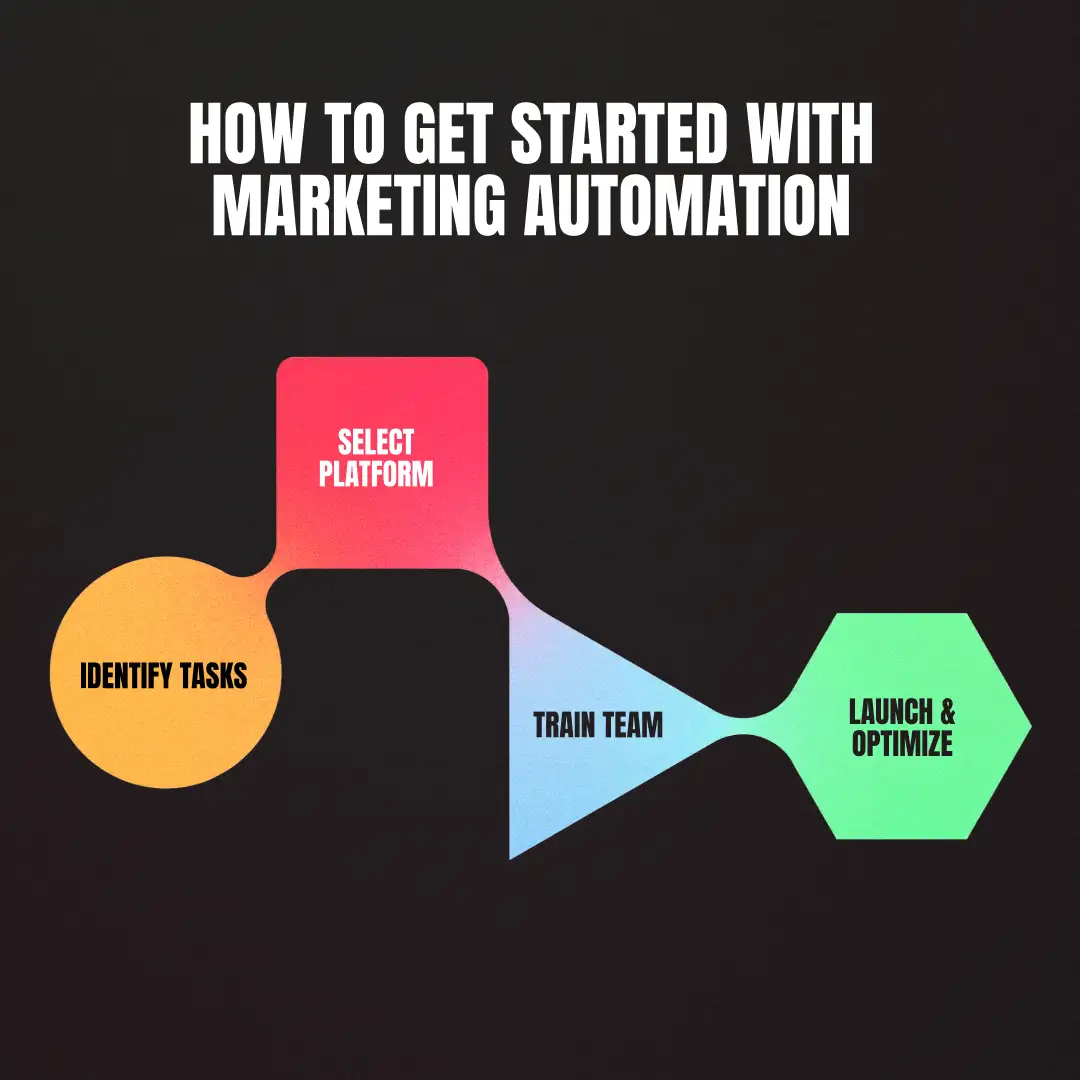
An automated marketing process does not require you to rush into things in the first few weeks. Here’s a strategic sequence that will help you avoid the rush and establish a strong foundation for your next marketing campaign:
- Identify the right tasks to automate
Start with tasks that are repetitive, high-volume, and don’t require judgement calls. This can include everything from welcome emails and lead routing to cart reminders and more.
- Select the right platform
Match the platform to where your data already lives and which channels your audience actually uses, not to whichever tool has the longest feature list. A marketing automation software that’s hard to integrate with your CRM will cost more in workarounds than it saves in automation.
- Train your team (and align with AI tools)
The platform is only as good as the people running it. Teams need to understand not just how to build a workflow but also how the AI/predictive layer is making decisions; otherwise, it becomes a black box nobody questions when something underperforms.
- Launch, monitor, and optimize continuously
The first version of any workflow is a draft, not a finished product. Watch performance closely in the first few weeks. You need to adjust triggers and content based on what’s actually converting and keep refining; automation isn’t a set-once project.
Choosing the Right Marketing Automation Platform
The right platform depends less on features and more on how well it fits how your team actually sells and how your data already lives. That fit matters even more now that most platforms lean on AI-first marketing services to do the heavy lifting behind the scenes.
A few platforms worth knowing
| Platform | Best Suited For |
| HubSpot | Teams that want an integrated CRM + automation in one place, without stitching together separate tools |
| Adobe Marketo | Complex B2B lifecycles with longer sales cycles and Salesforce as the source of truth |
| Braze / Iterable | Omnichannel consumer brands needing deep cross-channel orchestration, not just email |
| Klaviyo | E-commerce teams prioritizing email and SMS depth over broad channel coverage |
| Salesforce Marketing Cloud | Enterprises already deep in the Salesforce ecosystem, needing tight CRM-to-campaign sync |
What to look for depending on your marketing automation use cases
| Factor | Why It Matters |
| AI/predictive capabilities | Determines whether the platform can score leads and personalise decisions or just execute pre-set rules |
| CRM integration | Weak integration is the single biggest reason sales and marketing data end up siloed |
| Channel coverage | Some platforms go deep on email; others cover omnichannel, match this to where your audience actually is |
| Scalability & pricing model | Contact-based pricing can get expensive fast as your list grows; understand the tiers before committing |
| Ease of adoption | The most powerful platform is useless if your team avoids using half its features |
Questions to ask before adopting a platform
- Does this integrate cleanly with the CRM we already use, or will we need custom middleware?
- Can our team actually build and maintain workflows here, or will we be dependent on outside consultants?
- Does the AI/predictive layer work out of the box, or does it need months of data before it’s useful?
- What does this cost once our contact list doubles, not just at our current size?
How to Measure Marketing Automation ROI
If you still think that the best way to measure the success of your marketing automation strategy is to track opens and clicks, you won’t be able to justify the cost. For a revenue-focused measurement, here are the things you need to look at:
| Metric | What It Tells You |
| Revenue per campaign | Which sequences are actually closing deals, not just generating opens |
| Cost per acquisition (CPA) | Whether automation is genuinely lowering the cost of a new customer |
| Lead-to-customer conversion rate | Whether nurturing is moving people forward, not just keeping them warm |
| Sales cycle length | Whether automation is shortening the time between interest and close |
| Customer lifetime value (CLV) | Whether automated retention flows are increasing long-term value, not just first-sale revenue |
Expert Tip: Open rates and click-through rates still matter, but only as early signals; they explain why a number moved, not whether the number that matters actually did.
Costs to Factor in While Measuring Marketing Automation ROI
- Platform licensing and per-contact pricing tiers
- Implementation and integration costs, especially connecting automation to a CRM or CDP
- Content creation costs, sequences, creative variants, and ongoing updates
- Training time and internal bandwidth spent managing the system
Skipping this side of the equation is the most common way ROI gets overstated; a campaign can look highly profitable if the platform and setup costs never enter the calculation.
Common Measurement Traps to Avoid
- Measuring ROI too early, before a full sales cycle has actually played out
- Treating engagement metrics (opens, clicks) as if they were revenue metrics
- Comparing performance across campaigns that target completely different funnel stages
- Attributing an entire deal to the last touchpoint before close, ignoring the sequence that built interest
Real-World Examples: Brands Winning with Marketing Automation
These marketing automation examples aren’t hypothetical; these are the brands that are automating their process at scale, with real numbers to back them up.
-
Sephora
Sephora’s automation runs on predictive analytics tied directly to purchase behavior, not scheduled promotions. When a VIB loyalty member’s purchase frequency drops below their normal pattern, the system automatically triggers a personalized re-engagement offer.
This offer can include a sample or early sale access tailored to that specific customer’s beauty preferences and history. The AI-driven recommendation engine behind this has pushed average order value up 25% and repeat customer rate up 17%.
| What you can learn: Automation works best when it’s triggered by a change in behavior, not just the behavior itself. Watching for drop-offs, not just engagement, is what makes the re-engagement timely instead of random. |
-
Airbnb
Airbnb’s automation runs almost entirely on behavioral triggers rather than scheduled blasts. Browse a destination without booking, and you’ll get a follow-up email featuring similar listings in that same city.
So, as soon as a customer completes a stay, a review request along with personalized recommendations for their next trip follows automatically, based on where they’ve already shown interest.
| What you can learn: The follow-up doesn’t need to sell the same thing again — it needs to extend the intent the user already showed. Suggesting similar listings works better than repeating the exact one they didn’t book. |
-
Netflix
Netflix’s recommendation engine is, functionally, marketing automation working at a scale most companies never reach. Every thumbnail, row order, and “because you watched” suggestion is generated per account and updated continuously as viewing behaviour shifts. The automation isn’t limited to email or ads; it’s the entire interface adjusting itself.
| What you can learn: Personalisation doesn’t have to live only in email or ads; it can be built into the product experience itself, updating continuously instead of running on a campaign schedule. |
Future Trends: Where AI Is Taking Marketing Automation Next
Everything covered so far is already running in some form today. What comes next is less about new categories of tools and more about how much decision-making shifts from a person clicking approve to the system acting on its own. A few shifts worth watching:
- Real-time optimization as the new norm
Weekly or monthly campaign reviews are becoming too slow. Systems now adjust send times, offers, and targeting continuously, based on what’s happening in the moment rather than on what happened last week.
- Intelligent cross-channel orchestration
Instead of email, ads, and on-site personalization running as separate efforts, platforms are increasingly coordinating all three so a customer’s experience stays consistent no matter where they show up.
- Privacy-first, first-party data strategies
As third-party cookies keep fading out, automation is leaning harder on data customers give directly, purchase history, on-site behavior, preference centers, making consent and transparency part of the strategy, not just compliance.
- Agentic AI and autonomous campaign management
The next step beyond predictive scoring is systems that don’t just recommend an action but execute and adjust entire campaigns with minimal human input, flagging only the decisions that genuinely need a person’s judgement.
- AI-generated answers becoming a new discovery channel
As more buyers ask AI tools directly for recommendations instead of searching and scrolling, marketing automation is starting to factor in how a brand shows up inside those generated answers, not just on a results page, making answer-engine visibility as much a part of the funnel as email or ads.
Built AI-Native, Not Retrofitted for It
AI-first marketing across SEO, social, paid, and automation, engineered in from day one, not bolted on later.
How Appinventiv Digital Can Help You With Marketing Automation
Everything covered in this marketing automation guide, the flows, the ROI tracking, and the platform selection, still needs someone to actually build and connect it. That’s where we come in.
Most marketing teams don’t need another platform login; they need someone to fix where the hours are actually going. At Appinventiv Digital, that starts with a discovery audit, not a proposal.
Our marketing automation services aren’t a one-size-fits-all setup. We map exactly where a team is losing time to manual reporting, lead routing, campaign QA, or copy-pasting between tools that don’t talk to each other before anything gets built.
What gets built, specifically:
- Custom marketing automation bespoke systems for the repetitive work eating a team’s week: reporting, lead routing, lead scoring, campaign setup, and nurture flows. Based on Appinventiv Digital’s own experience automating these workflows for clients, this recovers up to 6 hours per week per task area.
- Custom AI agents built to own one repetitive, judgement-light task end-to-end (lead qualification and copy drafting) with human checkpoints at every decision that matters. The agent handles the task; the team still handles the call.
- Tool synchronisation connecting an existing stack (Salesforce, HubSpot, Marketo, Klaviyo, Mailchimp, Google Analytics, Segment, Snowflake, and more) so it runs as one system with two-way sync instead of disconnected tools passing data by hand.
- LLM integration bringing a team’s own data into natural-language querying and retrieval-augmented answers, so reports and context are available on demand instead of waiting on someone to compile them.
Why brands can trust our process
Our process is built to be transparent end-to-end, from discovery audit, automation blueprint, tool synchronization architecture, build and QA in a sandbox, and handoff with full documentation and training to ongoing optimization as the stack evolves. Nothing is locked behind the agency after handoff.
And the results aren’t hypothetical
- A D2C e-commerce brand saw recovered cart-abandonment revenue climb roughly 25% in the first full quarter after a custom automation layer connected their store, email platform, and CDP.
- A B2B SaaS company cut lead response time from days to minutes with a custom scoring and routing system backed by an AI agent for first-pass qualification.
- An enterprise B2B services firm brought monthly reporting time down from a full day to under an hour using an LLM integration layer across six previously disconnected tools.

Whether It's One Bottleneck or Your Entire Funnel, We'll Build the Fix
From a single automated workflow to a full marketing system rebuild, we scope it around what your team actually needs.
Turning Automation into a Revenue Engine
A marketing campaign automation does not work if it remains theoretical. The gap between teams where automation just saves time and teams where it actually drives revenue comes down to a few decisions, not a bigger budget.
If you’re taking one thing from this guide, make it this: stop measuring automation by what it saves you, and start measuring it by what it makes you.
A few things worth doing this week, not eventually.
- Pick your highest-volume sequence (cart recovery, lead nurture, onboarding) and check if it’s actually adjusting to behavior
- Pull your real numbers, revenue per campaign and cost per acquisition, not just open rates, before deciding anything is or isn’t working
- Name your biggest bottleneck; the one manual task eating the most hours every week is usually the clearest place to automate first
- Ask where AI is actually deciding, not just assisting. If your platform’s “AI features” are just labels on the same static rules, that’s not the upgrade it’s marketed as
Marketing automation that drives revenue isn’t the automation with the most features. It’s the automation built around what your team actually does, connected to real behavior, and treated as something to keep refining rather than a project you finish once. Start with the one flow that’s costing you the most right now; the rest follows from there.