




FAQs
When should you start planning a Black Friday campaign?
For D2C brands, 6 to 8 weeks before Thanksgiving. Warm-up work (list growth, creative tests, gift guides) pays off in lower costs when everyone else is bidding up the auction.
Is deep discounting necessary to win on Black Friday?
Not by default. Klaviyo’s data showed brands with the smallest discounts grew fastest. Offers like bundles, shipping thresholds and early access often protect margin better than a flat percentage cut.
Are holiday Facebook ads still worth it?
Yes, but the job changes. Prospecting gets expensive at peak, so use the weeks before to build audiences and use peak spend to convert warm ones.
What should D2C brands do after Christmas?
Run a deliberate post-peak campaign: gift card redemption, easy exchanges and a New Year angle. Shoppers are still buying.
Cyber Week, the five days everyone plans around, has made up roughly 17% of US online holiday spend for five years running. In 2025 it was $44.2 billion out of a $257.8 billion season, according to Adobe’s Cyber Monday recap and its full-season report. Adobe’s 2026 forecast puts it at 17.3% again. So about 83 cents of every online holiday dollar gets spent somewhere else.
Most people would take it as a sign that Black Friday now matters less. But! In reality, it means most brands are pouring their Black Friday marketing budget, creative and sleep into the narrowest slice of the season, while demand quietly spreads out around them. Adobe counted 25 days in 2025 with more than $4 billion in US online spend, up from 18 the year before.
The aim of this piece is simple. Holiday marketing has changed in structure, not just in volume. The season is no longer a runway with one big takeoff. It’s a set of overlapping demand windows, each with its own shopper mindset, its own cost of attention and its own way of going wrong.
The article walks through how the calendar got rewritten, what the sales data says, how shoppers actually behave, which tactics hold up, and where things are heading.
How the Festive Calendar Got Rewritten
The old sequence is gone
A decade ago the holiday retail calendar read like a list: Thanksgiving, Black Friday, Small Business Saturday, Cyber Monday, then a quiet slide to Christmas. Today it behaves more like a Venn diagram. Deals start in October, Cyber Week bleeds into the weeks on either side, and the real post-Christmas rush now has a name of its own.
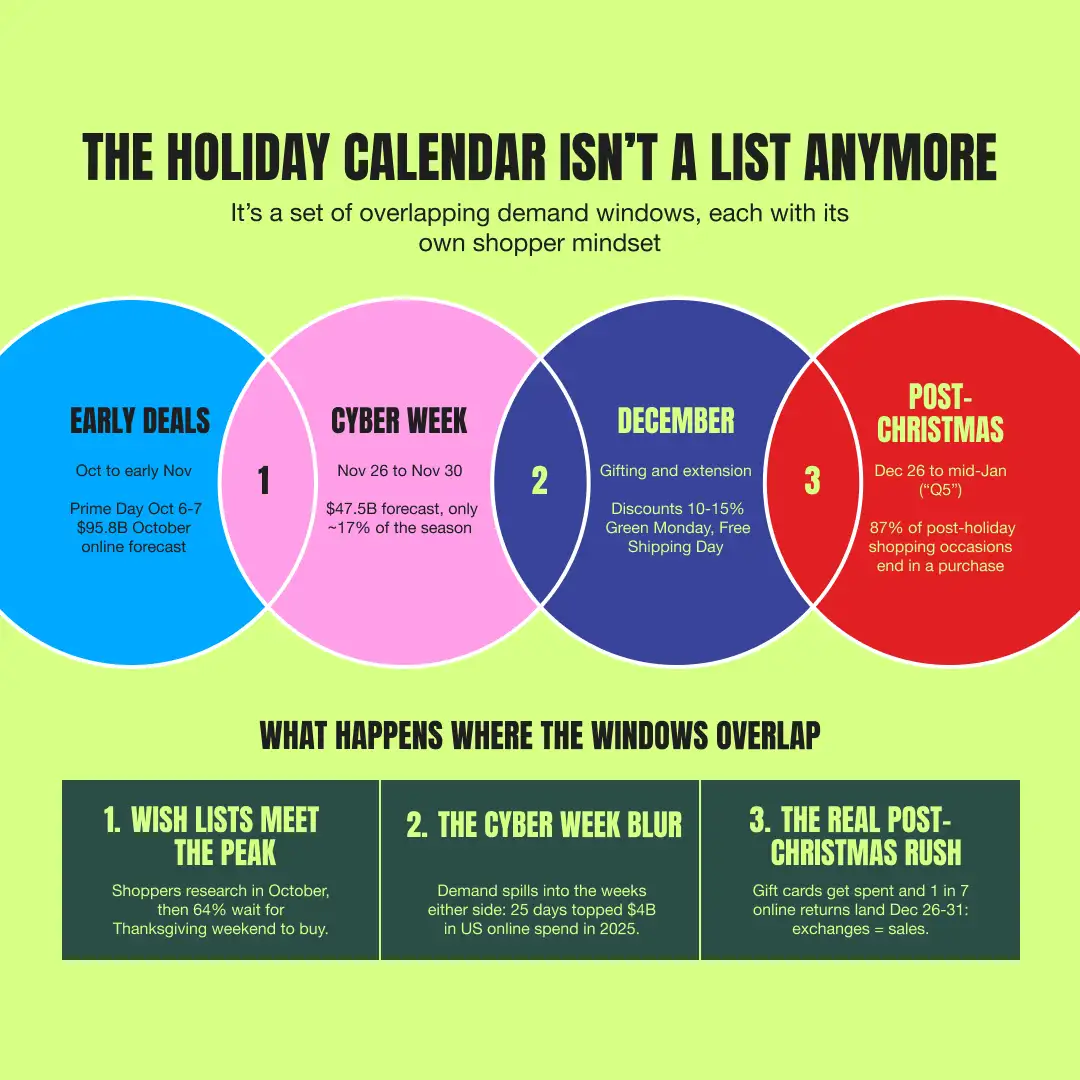
Adobe called out the October shift directly. Its 2026 forecast expects $95.8 billion in US online spend in October and says the October Prime Day event ($9.9 billion, with discounts up to 19%) “has changed the shape of the holiday season.” Whether you run Black Friday ecommerce promos or not, your customers are already being trained to shop early by someone else’s sale.
Day by day: where the money lands
| Key day | 2025 actual (US online) | 2026 forecast | What’s changing |
|---|---|---|---|
| Thanksgiving Day | $6.4B (+5.3%) | $6.9B (+8.5%) | Growth picking up; 63% of spend expected on mobile |
| Black Friday | $11.8B (+9.1%) | $12.9B (+9.2%) | Now the growth day, ahead of Cyber Monday for a second year |
| Cyber Monday | $14.25B (+7.1%) | $15.1B (+6.2%) | Still the biggest day ever, but growing slower |
| Cyber Week total | $44.2B (+7.7%) | $47.5B (+7.4%) | Holds at roughly 17% of the season |
Source: Adobe Analytics, 2025 Cyber Monday recap and 2026 forecast. Adobe covers US online spend only.
Look at the Black Friday to Cyber Monday ratio. In 2022, Black Friday was about 81% the size of Cyber Monday. By 2025 it’s 83%, and Adobe’s forecast takes it to roughly 85% in 2026. Cyber Monday has become the last call. Black Friday is where the growth is.
The people data tells a similar story. The NRF’s post-holiday survey counted a record 202.9 million shoppers across Thanksgiving Day to Cyber Monday in 2025, but Black Friday itself slipped, with in-store headcount down from 81.7 million to 80.3 million. Sunday in-store traffic jumped 27%. Demand didn’t disappear from Friday. It wandered into the weekend and into Monday.
The calendar quirk nobody’s talking about
Thanksgiving lands on November 26 this year, which is as late as it gets. Mastercard’s Economics Institute points out that this squeezes the run-up to Christmas, and that Cyber Monday (November 30) now sits in November instead of December 1 like last year. A practical consequence: if you compare November to November, you’ll fool yourself. Judge the season on the full November 1 to December 31 window.
The “Cyber Week” blur and the smaller days
Cyber Week stopped being a tidy five-day block a few years ago. Adobe’s discount curve for 2026 shows why. Discounts of up to 14% in early November, up to 21% just before Thanksgiving, up to 30% across Cyber Week, then 10 to 15% through December. That’s not a spike. That’s a staircase.
The smaller events matter more than their names suggest. Small Business Saturday gives independent D2C brands a hook that big retailers can’t borrow without sounding silly. Green Monday (the second Monday of December) and Free Shipping Day (mid-December) catch people who missed the first wave or who wait deliberately for shipping cut-offs.
Boxing Day carries a lot of the UK and Commonwealth post-Christmas buying, and in the US the week between Christmas and New Year is now a real retail moment, not a dead zone. Christmas marketing campaigns that only start on December 15 are already playing catch-up with shoppers who’ve been planning for weeks.
The takeaway: brands that treat Black Friday as a single day are leaving the season’s best-performing weeks unused. Plan the calendar as overlapping windows and give each one its own offer, audience and budget.
What the Sales Data Actually Shows
Record revenue, slower growth
US online holiday spend has nearly doubled since 2019. It’s also quietly losing momentum.
| Year | US online holiday spend (Nov 1 to Dec 31) | Growth |
|---|---|---|
| 2019 | $142.5B | +13.1% |
| 2021 | $204.5B | +8.7% |
| 2022 | $211.7B | +3.5% |
| 2023 | $222.1B | +4.9% |
| 2024 | $241.4B | +8.7% |
| 2025 | $257.8B | +6.8% |
| 2026 (forecast) | $275.1B | +6.7% |
Source: Adobe Analytics, 2025 season report and 2026 forecast.
Here’s the bit that gets lost in the “record-breaking” headlines. Much of that growth is price, not people buying more stuff. Mastercard’s forecast for US retail (excluding autos and gas) is +5.5% nominal, with 2.8 points of it inflation. Real growth is closer to 2.7%. The NRF’s own number is a nominal 4.2% to a first-ever $1.013 trillion, after 2025 closed at 3.1% and $972 billion.
Translation for a D2C marketer: holiday ecommerce is a slow-growth pie, so your growth has to come from taking a bigger slice of it. That’s a different job than riding a rising tide.
Mobile, desktop and the store
Mobile took 56.4% of US holiday online spend in 2025 and Adobe forecasts 57.4% for 2026. On Thanksgiving Day it’s expected to hit 63%. If your checkout still feels like a desktop experience squeezed onto a phone, you’re losing the day’s best traffic.
But don’t write off stores. The NRF’s October survey found only 53% of shoppers plan to shop online, the lowest since 2015, and the share of holiday shopping people expect to do online fell from 56% to 52%. Mastercard’s forecast has in-store growth at +3.6%, its best in four years.
Meanwhile, Salesforce found nearly one in five orders last season used click-and-collect. The honest reading: online dollars are still growing, but shoppers are mixing channels more freely than a “digital-first” plan assumes. D2C brands with pop-ups, retail partners or marketplace listings should treat them as part of the same funnel.
Are you buying revenue with margin?
This is the question that separates a good season from a good-looking one.
Adobe’s forecast has discount depth flat year over year. Electronics hit 30.1% off at peak in 2025, toys 28%, TVs 24.2%, apparel 23.2% (Adobe). Everyone’s playing the same game at the same price points.
The most interesting data point of the season came from Klaviyo’s 2025 BFCM report. Across a stable group of 10,000 brands, same-site sales grew 11% while average discounts fell 10%. The brands with the smallest discounts grew fastest, at 14%. (Home and Garden was the exception and needed deeper markdowns.)
Klaviyo’s data covers its own customer base, so read it as direction, not market sizing. The direction is clear, though: deep discounts aren’t the growth engine many brands still assume.
Then there’s the bill that arrives after the party. Adobe reports that 1 in 7 online returns happened between December 26 and 31, and Salesforce estimates roughly 14% of global online holiday purchases came back. Gross revenue is a vanity metric in this season. Net revenue after discounts, shipping and returns is the number your CFO will remember in February.
How Shopper Behaviour Has Changed
They research early and buy on the day
Everyone says holiday shopping starts earlier. The data says it’s more complicated. The NRF’s survey shows the share of people who start before November is stuck around 43%, basically where it’s been for years. What changed is how deliberate they are. 64% say they’ll wait until Thanksgiving weekend for most of their shopping, up from 51% five years ago (NRF).
Two-speed behaviour, in other words. People build wish lists in October and pull the trigger on the peak day. Google’s holiday research says the same: shoppers keep tabs open waiting for sales, and “deals” searches spike more than 2,300% in Black Friday week compared to September.
That’s why Salesforce’s mid-year data is so telling. Global traffic was up 18% in Q2 2026 while order volume rose just 1%, with cart abandonment at 82%. Attention is cheap to get and expensive to convert. If your October plan is “run awareness, hope for November,” you’re feeding a funnel that leaks.
Price sensitivity is structural now
56% of NRF respondents said the economy affects their holiday plans. Of those, 43% will shop sales more often, 31% will compare prices online more and 29% will use more coupons (NRF). When asked what decides where they shop, 56% said sales and discounts, 51% quality, 46% selection and 37% free shipping or promotions.
Buy now, pay later is the clearest sign. Adobe tracked $20 billion of BNPL online spend in the 2025 season, up 9.8%, and Cyber Monday became the first single day to cross $1 billion in BNPL. Its 2026 forecast has the total at $21.3 billion, with about 82% done on mobile. Shoppers aren’t just waiting for lower prices. They’re financing the peak.
And there’s no single “average shopper” anymore. Salesforce describes a K-shaped consumer: 52% of low-income shoppers feel pessimistic about the economy, against 36% of high-income ones, and 35% of all shoppers say they’re trading down. Holiday retail marketing that talks to everyone the same way ends up talking to nobody. Segment by wallet, not just by age or interest.
Loyalty vs. deal-hopping
Retention wins at the peak. Klaviyo found repeat-customer revenue grew 13.5% across Black Friday to Cyber Monday, ahead of new buyers at roughly 9%, helped by early access, VIP tiers and personalised offers (Klaviyo). Your existing customers are the cheapest, warmest audience you’ll have all year, and most brands still spend the bulk of their peak budget trying to find strangers.
Gifting vs. self-purchase
Adobe’s 2026 data shows deals being used to stock up as much as to gift. During Cyber Week, personal hygiene purchases run 150% above the September average, clothing basics 210%, baby products 113% and pet products 93%. Plenty of people treat Black Friday as the household restock.
On the gifting side, the NRF found 27% plan to give an experience (up from 19% five years ago) and 47% put a gift card on their own wish list. Those gift cards matter later. Google’s “Q5” study, covering eight markets over the 2024 to 2025 season, found 87% of post-holiday shopping occasions end in a purchase, and 84% of shoppers use Google or YouTube in that period.
Where discovery happens
| Channel | What the data says | Source |
|---|---|---|
| Google properties | 87% of holiday shoppers use them to research | Think with Google |
| Social | 65% use it to research; social purchases up 17% YoY; brand social shops are 7 to 9% of orders | Think with Google |
| Marketplaces | 59% use them to research | Think with Google |
| AI assistants | Use as a first stop up 200% in a year; half of shoppers use one somewhere on the way to a purchase | Salesforce |
| Your own site | Engagement on brand-owned properties down 7% YoY | Salesforce |
Salesforce’s numbers are the most uncomfortable ones for anyone leaning on search. Shoppers using traditional search and marketplaces are each down 15%, while AI assistants and social are up 38%. Discovery is leaving your website and moving upstream to places where you don’t control the experience.
The takeaway: shoppers are more informed and less impulsive than most playbooks assume. They arrive with a shortlist, a price in mind and a willingness to wait. Your job is to be on the shortlist before the sale starts.
What’s Working in Festive Marketing Tactics
Email and SMS carry more of the load than most budgets admit
Klaviyo’s data shows email and text accounted for 42% of revenue across its brands over BFCM, 43% on peak days. Customers reached on both channels placed 11% more orders and added 34% more items to cart than single-channel customers (correlation, not proof, but a strong signal).
Volume has limits, though. Text revenue grew 25% on 34% more sends. More messages, thinner returns. Blasting the whole list is the lazy version of a holiday marketing strategy. Segmenting by recency, category and past discount response is the version that holds up.
Klaviyo also found AI product recommendations drove a 71% increase in revenue from recommendations, which tells you that shoppers browse more and want help narrowing choices.
Paid media: the price of attention goes up in Q4
Anyone who’s run holiday Facebook ads knows what November does to the auction. Triple Whale’s benchmarks across tens of thousands of brands show Meta CPMs around $22.26 during BFCM 2025, against a year-round median near $15. ROAS for Meta sat around 2.26, with CPA near $34. Google’s BFCM ROAS fell sharply year over year. TikTok was the outlier, with cheaper CPMs and rising ROAS, though from a small spend base.
Adobe’s channel forecast backs up the shift. Social is expected to take 17% more share of revenue and affiliates and partners 12%, while paid search grows just 4% (Adobe). Cashback sites make up 36% of affiliate traffic and creators 22%.
The pattern is hard to miss. Prospecting at peak is expensive. The efficient play is to warm audiences before the auction heats up, then spend peak budget on people who already know you.
ChatGPT Ads: the newest line on the media plan.
Shoppers are building shortlists inside chat windows now, and OpenAI has put ads there. By OpenAI’s own numbers, retail and ecommerce conversations run past 1.7 billion prompts a week, about 43% of shopping chats involve comparing options, and US product-search activity on ChatGPT rose 52% over the 2025 holiday season (94% on Black Friday, against matched weekdays).
On the supply side, OpenAI says ChatGPT Ads passed a $1 billion annualized revenue run rate in under 200 days, now sells in 40+ countries through a self-serve Ads Manager, and that cost-per-click and outcome-based bidding make up most campaigns. The same page cites one ecommerce advertiser at a 3x return on ad spend over 28 days. That’s a single case study from the seller, so read it as a signal and not a benchmark.
ChatGPT is a test line, not a Black Friday bet. Set a capped budget, carved out of prospecting and not out of retention. Get conversion tracking and your product catalogue in place first (OpenAI’s own holiday guidance says the same), and run a holdout so you can see what’s incremental.

Paying peak-season prices for attention? Make every click earn its place.
Our performance marketers plan, test and scale campaigns across Meta, Google and AI platforms so every festive dollar works harder.
Offer structure beats offer size
Salesforce expects free shipping to be the number one decision factor across all income levels, with retailers spending about $3 billion more subsidising it globally. A threshold offer (“free shipping over $75”) often does more for margin than an extra five points off, because it lifts basket size and costs you nothing on orders that would have been smaller.
A few holiday promotion ideas that fit what the data says:
- Tiered bundles that raise average order value without a blanket markdown.
- Gift guides by recipient and budget, published early, since shoppers research in October.
- Early access for past buyers and VIP tiers, which matches the repeat-customer lift Klaviyo saw.
- Threshold-based shipping or gift-with-purchase in place of flat percentage cuts.
- A deliberate post-Christmas offer, aimed at gift card holders and returners. Christmas marketing doesn’t stop on the 25th.
Where the Trends Point Next
Forecasts miss in both directions (Adobe’s 2025 season forecast of $253.4 billion landed under the $257.8 billion actual), so these predictions are about direction, not magnitude. Each one is tied to a trend already in the data.
1. The sales window keeps stretching and flattening
Prime Day in October, 25 days above $4 billion, a staircase of discounts from early November to year end. The peak is turning into a plateau. What to do differently: plan budgets by demand window, not by event, and stop assuming that Cyber Monday is the finish line.
2. Retention beats acquisition when real growth is this thin
With real growth near 2.7% (Mastercard) and repeat revenue outpacing new-buyer revenue, share-taking from competitors is expensive and rewarding loyal customers isn’t. What to do differently: move 15 to 20% of your peak prospecting budget into early access, VIP and lifecycle flows. Measure repeat rate as a headline metric, not an afterthought.
3. AI-assisted discovery goes mainstream
Adobe forecasts AI traffic to US retail sites up 130% year over year. In Adobe’s July survey of 5,000 consumers, 77% of AI-using shoppers said they felt more confident about what they bought. Salesforce reports 74% trust AI chat recommendations, and Mastercard notes that AI-heavy shoppers spread spend across more merchants, including smaller ones.
That last point is good news for independent D2C brands. What to do differently: make your product pages readable by machines (clear specs, honest FAQs, structured data), and track AI referrers in GA4 separately this season.
4. January becomes a growth window, not a hangover
Google’s Q5 research shows high purchase intent after December 25. Adobe saw one in seven returns land between the 26th and the 31st, which means exchanges are a sales opportunity too. And with 47% of shoppers wanting gift cards, there’s money waiting to be spent. What to do differently: build a dedicated Q5 campaign, with exchange-friendly returns, gift card nudges and a “fresh start” angle in your New Year messaging.
5. Full-funnel measurement replaces last-click
Traffic up 18% against orders up 1%, social shops at 7 to 9% of orders, AI assistants influencing purchases that end on a different site. Last-click credit gets this wrong more every year. What to do differently: run a holdout on one channel this season, track new vs. returning customer revenue, and judge social and AI by assisted conversions as well as direct ones.
Conclusion
The festive season stopped being an event a while ago. It’s a stretch of overlapping windows, and brands that still plan around one Friday are working from a map that’s ten years out of date.
The data keeps pointing the same way. Shoppers research in October and wait for the peak. Owned channels and repeat buyers carry more of the load than most budgets admit, paid attention gets pricier by the week, and newer discovery channels like ChatGPT are worth testing without betting the quarter on them.
None of this calls for a bigger budget. It calls for an earlier start, a tighter read on margin and a plan that treats December 26 as part of the season.