


FAQs
What is the difference between SEO, AEO and GEO?
SEO centres on getting traffic to the website by leveraging traditional search results. AEO is designed for getting immediate responses to voice or snippet queries. GEO ensures that the AI models are based on your brand, so you are referenced as a trusted source for generative responses.
How are SEO, AEO and GEO different?
The key difference between them is their ultimate goals and locations. SEO has regular website traffic. AEO achieves a zero-click featured snippet for Google. Whenever AI models, such as ChatGPT, Gemini and Perplexity, generate conversational answers, GEO puts your brand on them.
SEO vs AEO vs GEO which is better?
There's no right or wrong, they're for different things. It's important for local businesses to focus on SEO and AEO for quick visibility. But for B2B brands, the power of GEO is significant to outsmart AI-powered research and ensure their impact on multichannel, long-tail buyer journeys.
How to optimize content for AI search?
For AI search optimization, prioritize original research, in-depth knowledge, and robust connections to entities. Give short, factual answers right under headings, use common schema markup and make sure to add direct quotes and stats that AI models enjoy citing.
Can SEO, AEO and GEO work together?
Absolutely. They form a collaborative "Triangular Strategy." Solid technical SEO ensures bots can crawl your site. AEO formats your content for easy extraction. GEO adds the proprietary data and authoritative citations needed to win in generative AI summaries.
Search has officially fractured. A few years ago, you had one primary surface: a search engine that gave you a list of blue links, and your job was to fight your way into the top three. Today, a user’s search journey might start on ChatGPT, detour through a TikTok search bar, validate on Perplexity, and finally end up on a Google AI Overview.
The playbook has shifted entirely. We are no longer just optimizing for a search results page. We are optimizing for multiple surfaces that digest and spit out information in entirely different ways.
The Pew Research data tells the same story. The study tracked real browsing sessions and saw people click a traditional result in 8% of visits when an AI summary appeared, against 15% when it didn’t.
To survive this shift, modern discoverability now hinges on a strategic trio: SEO (Visibility), AEO (Instant Answers), and GEO (AI Citations). But if you’ve read a few SEO vs AEO vs GEO posts and walked away more confused than you started, that’s fair. They contradict each other, and a few even use “GEO” to mean something else entirely.
This article is your ultimate blueprint for future-proofing your brand’s digital presence and mastering the difference between SEO, AEO and GEO.
The Search Bar in 2027: Why Traditional SEO Is No Longer Enough
The transition was slow at first but picked up pace with a blink of an eye. We went from basic ten blue links to the introduction of featured snippets and voice search. Then came AI Overviews, full-blown AI Mode, and conversational ChatGPT search interfaces.
The unit of measurement for success is fundamentally changing. A user asking a complex question no longer wants to scrub through a 2,000-word recipe blog just to find out how much salt to add. They want the answer instantly, synthesized from multiple sources.
The Zero-Click Shift
Zero-click searches are the new normal. Recent studies put the zero-click rate for general Google searches at roughly 60–69%. And when you look at users operating in AI Mode or asking Perplexity a question, that non-click rate skyrockets even higher. The search engine resolves the query right there on the interface.
What This Means for Brands
Visibility now means being seen, cited, or recommended. If an AI tells a user that your software is the best for small businesses, that user might bypass visiting your site altogether and head straight to an app store or a checkout page later on. Your brand was visible, you won the mindshare, but you got zero website traffic from the initial query.
| Then (classic search results) | Now (answers and AI) | |
| What the user types | Short keywords | Full questions and multi-part prompts |
| What the engine returns | A ranked list of links | A synthesized answer, with sources attached |
| Where the decision happens | On your website | Often before the click, on the results page or in the chat |
| What “winning” looks like | Position 1 and a click | Being the answer, or being named as a source |
| Main metrics | Rankings, traffic, CTR | Citations, mentions, share of AI answers, plus traffic |
| Who you compete with | Pages on the same keyword | Every source the AI considers, including Reddit, YouTube and review sites |
Decoding the Three Pillars: SEO, AEO, and GEO
Acronyms are easy to define and hard to feel. So for each pillar, we’ll cover what it is and why it exists in the first place, meaning the human behavior it grew out of. That’s the part that tells you where to put your effort.
SEO (Search Engine Optimization): The Foundation of Discoverability
When people have a research task, they like to see options and judge for themselves. A page of links gives them a sense of control: that one looks like a big brand, this one looks like a forum, that snippet matches what I meant. SEO is the craft of earning a spot in that lineup and then convincing someone to pick you.
The focus is rankings, clicks, and the traffic that follows. The work usually falls into five buckets:
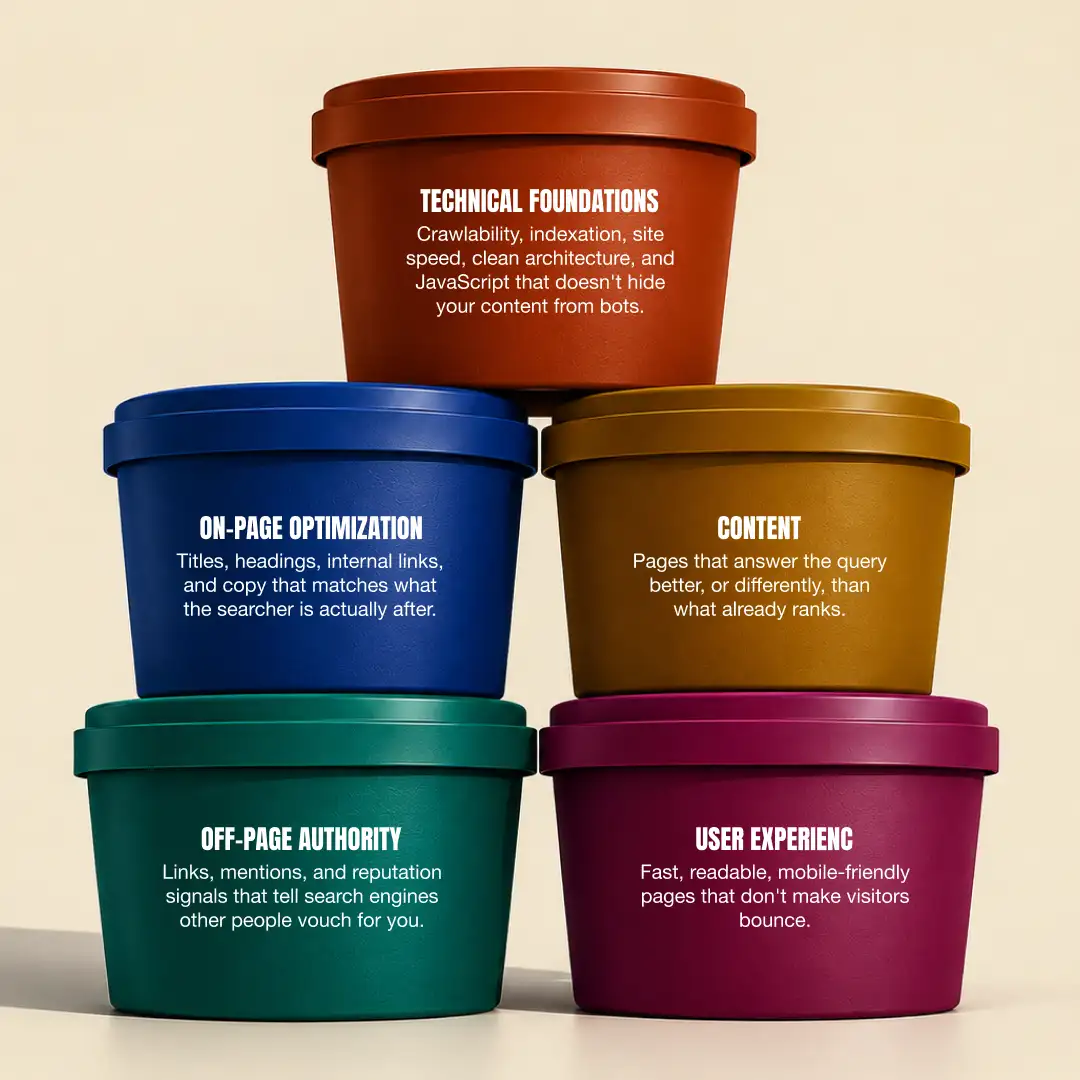
Search engine optimization is still mandatory, but its role has shifted from finish line to price of entry. It’s what gets your content into the pool that AI systems draw from. Ahrefs’ says that 38% of pages cited in AI Overviews also ranked in the top 10 for the same query, down from 76% in the same company’s study eight months earlier. So ranking helps, but it’s no longer the only road in.
AEO (Answer Engine Optimization): Winning the “Zero-Click” Game
Answer engine optimization is the practice of shaping your content so these answer engines can lift a clean, correct answer straight off your page. The target is to be the direct answer to a user’s query, whether that’s a featured snippet, a People Also Ask entry, a voice result, or a line inside an AI Overview.
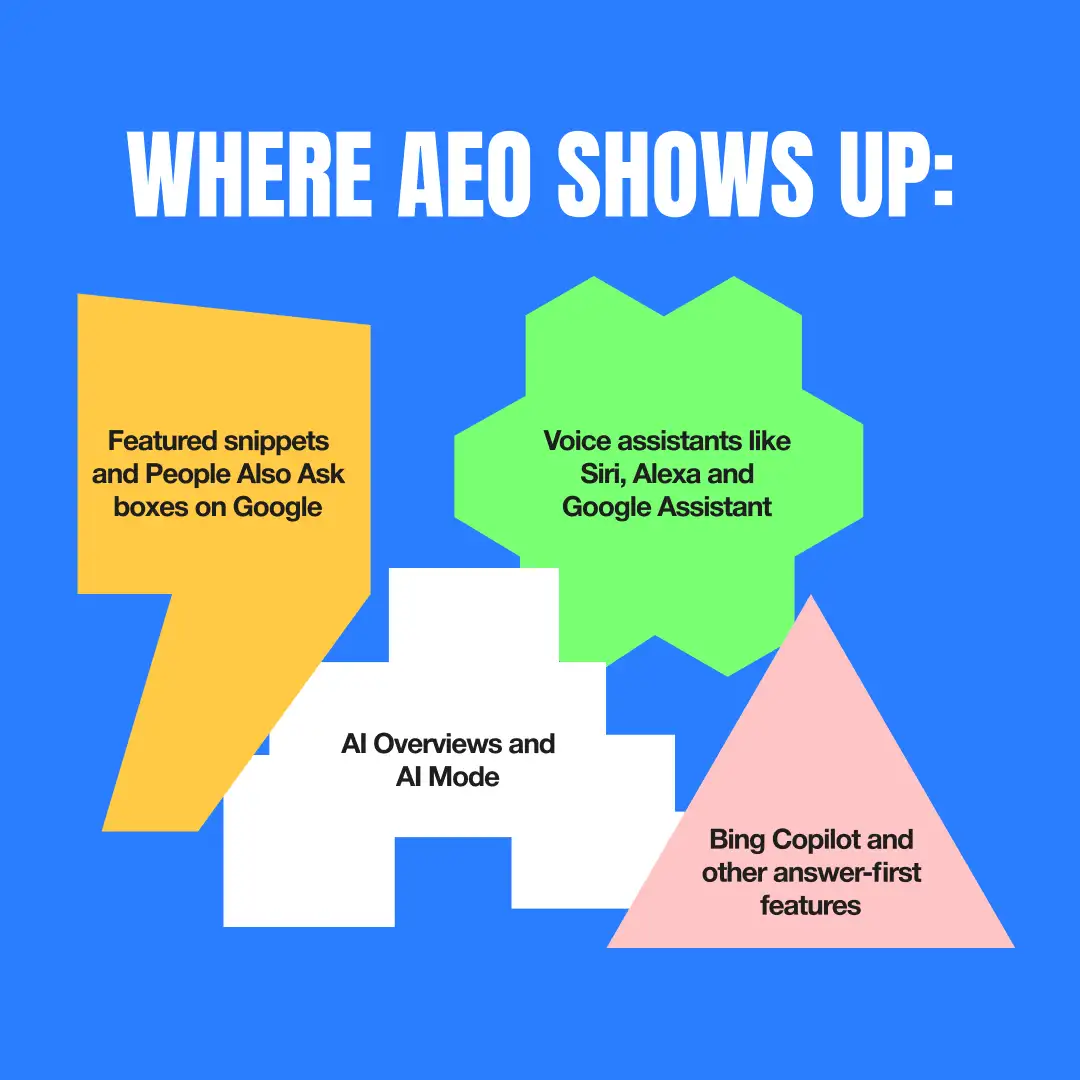
The core tactics are refreshingly practical:
- Put a direct response right under the heading, then expand.
- A heading like “How much does a standing desk cost?” beats “Standing desk pricing overview.”
- Numbered steps, short lists, comparison tables, and one-sentence definitions are easy for machines to lift.
- FAQ and HowTo style markup can help machines parse your page.
- Specific, verifiable and current wins over padded and vague.
GEO (Generative Engine Optimization): The New Frontier of AI Citations
GEO grows out of a different behavior. A lot of people no longer want a list at all. They want a recommendation. Generative engine optimization targets exactly that. Generative AI search tools like ChatGPT, Gemini, Perplexity and Claude retrieve material from the web, then write an original response, often with citations attached. GEO is about influencing which sources get pulled in and which brands get mentioned.
The core GEO tactics, in plain terms:
- Show real expertise (E-E-A-T). Experience, Expertise, Authoritativeness and Trustworthiness come from Google’s quality guidelines. Named authors, credentials, first-hand experience and clear sourcing give an AI more reasons to trust you.
- Publish original research. Proprietary data is the one thing a model can’t get from ten other pages. It’s also the easiest thing to cite.
- Optimize your entity. AI systems think in entities (brands, people, products, places). Make sure yours is described consistently everywhere.
- Cite your own sources. Back claims with data and link to the primary source. It makes your content more checkable, and checkable content is easier to quote.
- Earn mentions beyond your own site. Reviews, press, communities and video all feed what models learn about you. More on this in the platform section.
If SEO is about the page and AEO is about the answer, GEO is about the brand. That framing will keep paying off as we go.
SEO vs GEO vs AEO: The Complete Comparison
Understanding how these disciplines overlap (and where they violently diverge) is critical for resource allocation.
| Feature | SEO | AEO | GEO |
| Primary Goal | Drive website traffic via clicks | Own the direct answer without a click | Be cited as an authority in generated summaries |
| Where it Appears | Standard SERPs (blue links) | Featured Snippets, Voice, PAA boxes | Perplexity, ChatGPT, AI Overviews |
| Unit of Competition | The entire web page | A specific block of text/answer | The brand entity/citation link |
| Primary Signals | Backlinks, keywords, UX | Schema markup, concise formatting | Original data, quotes, semantic depth |
| Content Style | Long-form, comprehensive | Punchy, factual, scannable | Nuanced, authoritative, highly cited |
| Key Metrics | Organic traffic, rankings | Snippet ownership, voice share | Citation frequency, LLM brand sentiment |
| Time to Results | 3 to 6 months | Weeks (if indexed quickly) | 12 to 24+ months (tied to model training cycles) |
| Control Level | High | Medium | Low |
Overlap: what all three share
The table makes the three look like separate crafts. In practice, they share most of their DNA. They all rely heavily on flawless crawlability, high E-E-A-T signals, and the creation of genuinely original content. If your page is bloated, slow, and full of scraped information, it fails across the board.
Where They Diverge
The divergence happens in the packaging. AEO vs SEO is mostly a formatting battle. AEO requires you to strip out the fluff and give the answer in 50 words so an assistant can read it aloud.
GEO vs SEO, however, is an architectural battle. SEO wants you to optimize for a specific keyword phrase; GEO wants you to establish a robust, interconnected web of entities and proprietary data so an LLM inherently trusts your brand’s perspective on a topic.
Same Piece of Content, Three Optimizations
Abstract comparisons only go so far, so here’s one topic, “Best Running Shoes for Flat Feet,” treated three ways.
| Strategy | How it alters the content |
| The SEO Approach | Long-form guide, URL optimized (/running-shoes-flat-feet), optimized H2s, internal links to product pages, optimized images. |
| The AEO Approach | A bulleted summary right at the top under a clear H2: “The top 3 running shoes for flat feet are the Brooks Adrenaline GTS, Asics Gel-Kayano, and Hoka Arahi. These provide maximum arch support.” |
| The GEO Approach | Adding quotes from a certified podiatrist, referencing a 2025 biomechanics study on pronation, and including original survey data from 500 runners on shoe durability. |
Do AI engines even know you exist?
We'll check your crawler access, answer-readiness, and AI search visibility, then send you a clear list of what to fix first.
The Big Mix-Up: GEO, LLMO, AIO, SEvO, and “Geographic” GEO
Because the industry moves faster than a glossary can keep up, you’ll see a dozen acronyms floating around.
Why the Terms Overlap
Marketers love to coin new terms to sell consulting packages. LLMO (Large Language Model Optimization), AIO (Artificial Intelligence Optimization), and SEvO (Search Everywhere Optimization) are mostly just different flavors of the same core concept.
Cheat-sheet glossary
| Term | What it usually means | Watch out for |
| SEO | Earning rankings and organic traffic | Often used loosely to mean “anything search-related” |
| AEO | Being the direct answer in snippets, voice and AI answers | Definitions differ; check whether the author means snippets or AI chat |
| GEO (generative) | Getting cited or recommended in AI-generated responses | Term comes from a 2023 research paper |
| GEO (geographic) | Local and regional visibility | Usually called local SEO or international SEO elsewhere |
| LLMO | Essentially GEO, aimed at chatbots like ChatGPT | Mostly interchangeable with GEO |
| AIO | Either Google’s AI Overviews feature or a catch-all term | Context decides the meaning |
| SEvO | Optimizing across Google, YouTube, TikTok, Reddit, marketplaces and AI tools | A strategy umbrella, not a separate tactic set |
| AI search optimization | A generic label for SEO, AEO and GEO work aimed at AI-driven surfaces | Fine as shorthand, vague as a job description |
Why Geographic GEO is a Common Mix-Up
If you search for GEO, you might stumble into agencies talking about maps and local business listings. Geographic SEO (or Local SEO) is about optimizing your Google Business Profile to show up for “coffee shop near me.”
Generative engine optimization is entirely different, it’s about influencing AI models. Don’t let a local SEO agency sell you a “GEO package” that consists entirely of local directory citations.
Example: A quick test: if “GEO” shows up next to phrases like “near me” or “Google Business Profile,” you’re reading about geography. If it sits next to ChatGPT, Perplexity or citations, you’re reading about generative AI.
What Google Actually Says: Is AEO/GEO “Just SEO”?
Whenever a new framework pops up, purists will scream, “It’s all just good SEO!” Let’s look at what Google actually says, particularly drawing on their May 2026 guidelines regarding AI Overviews.
Google’s May 2026 Guide, Summarized
Google’s official stance remains somewhat conservative. They maintain that there is no magic button or separate indexing process for AI Overviews. If your page is indexed and eligible for standard search, it’s eligible for AI summaries.
It also explains the machinery. Google’s AI Overviews and AI Mode use retrieval-augmented generation (RAG), where the system pulls relevant material from the Search index to ground its answer, along with a technique called query fan-out.
What Google Says to Ignore
- Special LLM text files: You don’t need a secret llms.txt file to get crawled by Google’s AI.
- Over-engineering “chunking”: Writing in unnatural, robotic blocks just to appease an assumed AI parser.
- Inventing new schema: Stick to standard Schema.org; don’t invent custom markup thinking the AI will reward you.
- Inauthentic mentions: Buying fake brand mentions on Reddit to trick the AI into thinking you have community sentiment.
What Google Says to Focus On
- Non-commodity content: Information that cannot be easily replicated by a competitor or an AI.
- Snippets eligibility: Standard best practices for featured snippets.
- Page experience: If users bounce instantly, the AI models take note of the poor satisfaction signals.
The “Triangular Strategy”: How to Build the Triple-Optimized Content Framework
These three pillars collaborate, they don’t compete. SEO makes your page findable. AEO makes it extractable. GEO makes it worth citing. Skip a step and the whole thing sags. A page with great GEO-style research that Google can’t crawl never gets seen. A well-ranked page full of vague filler gets passed over by every AI that has better material to quote.
In practice, AI search optimization works best as three passes over the same piece of content, in this order.
Step 1: The SEO layer (intent and architecture)
Start where you always started: with what the searcher is trying to do.
- Pin down the intent
Search your target query and look at what’s actually there. Guides? Product pages? Videos? An AI Overview? That tells you what format the engines think people want.
- Map the sub-questions
Check the AI Overview and the People Also Ask box and write down every question they answer. Because of query fan-out, those related questions are often what the AI is really searching for behind the scenes. They make excellent H2s.
- Get the basics right
One clear H1, a descriptive title tag and meta description, clean URL, sensible internal links, a canonical tag, a mobile-friendly layout.
- Make sure crawlers can get in
No accidental noindex tags, no robots.txt rules blocking important sections, no content that only appears after a script nobody can render. Google’s guidance says pages need to be indexed and eligible for snippets to show up in its generative AI features, so check Search Console before anything else.
Step 2: The AEO layer (structuring for extraction)
Now rework the page so that answer engines can grab clean pieces of it.
- Open each major section with a direct answer.
Two or three sentences that resolve the question, then the explanation and nuance.
- Use formatting that gets lifted
Short paragraphs, bullet lists, numbered steps, comparison tables, one bolded key term per section. Don’t bold half the page; it stops meaning anything.
- Add schema where it fits
Article, Product, FAQ and HowTo markup can help machines understand the page. Keep expectations realistic: Google says there’s no special markup for AI features, so this is about clarity, not a loophole.
- Phrase headings like real questions
“What does a small team need from a project management tool?” will match more conversational queries than “Project management tool features.”
Step 3: The GEO layer (citable proof and originality)
This is where the page stops being interchangeable. AI systems want sources that look trustworthy enough to repeat. That’s what generative engine optimization is all about.
- Add proprietary data
A small survey, a benchmark from your own customers, an analysis of your internal numbers. Even modest original data gives a model something it can’t get elsewhere.
- Cite primary sources
Link to the study, the documentation, the dataset, not to another blog summarizing it. The Princeton team found that adding statistics, quotations and credible citations tended to improve visibility in generative engine responses, though results vary by topic.
- Treat your brand as an entity.
Use Organization schema with sameAs links to your official profiles, keep your name and descriptions consistent everywhere, build proper author pages, and keep your Google Business Profile and other listings tidy.
- Say new things
An original opinion or a hard-won lesson from experience is more quotable than a restatement of the consensus.
Search is changing fast! Let's plan for it.
We'll help you work out where SEO, AEO and GEO fit in your business. Tell us what you're working on, and we'll take it from there.
Mapping Content Types to the Right Optimization Strategy
Here’s a relief: not every page needs all three layers at full strength. Spending a week adding original research to your return-policy page would be a bit silly. Match the effort to what the page is for.
Technical docs, help articles and FAQs → lean on AEO
Users want quick, exact answers. Example: a “How do I reset my password?” page should open with the steps and keep them scannable. This is answer engine optimization at its most practical.
Opinion pieces and original research → lean on GEO
AI models summarize ideas and data, so this is where proprietary numbers, sharp takes and named experts earn their keep. Example: an annual “State of [your industry]” report that other sites link to and quote.
Commercial and product pages → SEO plus AEO
Buyers need visibility at the decision stage and fast answers on specs, pricing and availability. Example: a product page with a clear spec table, a short “who is this for?” answer, and clean product data.
Comparison and review pages → SEO plus GEO
These attract the “which one should I pick?” prompts that AI tools love to answer. Honest pros and cons, real testing and third-party validation beat thin listicles.
Platform-by-Platform Guide: Optimizing for Each AI Engine
If you want true AI search optimization, you need to understand the nuances of the major players.
| Platform | Index / Retrieval Source | Citation Behavior | Sources Favored | What to Prioritize |
| Google (AI Overviews) | Google’s Live Index | High citation of top-ranking organic pages | High E-E-A-T sites, traditional SEO winners | AEO formatting, standard SEO authority |
| Perplexity | Proprietary live web index | Aggressive, inline hyperlinking | Niche authorities, academic papers, Reddit | GEO (original data, quotes, high fluency) |
| ChatGPT (Search) | Bing Index + Internal training | Conversational flow, fewer direct links | High-tier media, Wikipedia, established brands | Brand PR, digital PR, unlinked mentions |
| Claude | Training data + selective retrieval | Cites docs and vendor pages heavily | Technical documentation, whitepapers | Deep, structured, factual content |
| Gemini/Copilot | Google/Bing ecosystems | Blends generative text with traditional SERP features | Ecosystem-integrated data (Shopping graphs) | Product feeds, Merchant Center integration |
Future-Proofing Your KPIs: Measuring Success Beyond “the Click”
Here’s the awkward question every marketing lead eventually asks: if the click isn’t the win anymore, how do we show ROI? It’s a fair one. A snippet win, a citation in ChatGPT or a brand name inside an AI Overview rarely shows up cleanly in analytics. Yet it can still shape who a buyer shortlists.
The fix isn’t to abandon your old metrics. It’s to add a second layer next to them. Here’s a working set for each pillar.
SEO metrics
- Keyword rankings for priority queries, tracked by topic cluster instead of single keywords
- Organic traffic and conversions, segmented by landing page
- Click-through rate from Search Console, watched alongside impressions (a falling CTR with steady impressions often signals an AI feature absorbing clicks)
AEO metrics
- Featured snippet ownership for your target questions
- People Also Ask wins
- Voice and assistant visibility where you can test it
- AI Overview appearances for tracked queries
GEO metrics
- Citation frequency across ChatGPT, Perplexity, Gemini and other engines
- Brand mentions, linked and unlinked
- Brand sentiment and accuracy in AI outputs (does the AI describe you correctly?)
- Share of voice versus competitors across a fixed set of prompts
- AI referral traffic and its conversion rate
Which Should You Prioritize? A Framework by Business Type
Where should you put your budget this year?
Local and Service Businesses
Forget heavy GEO for now. Prioritize SEO and AEO. You need your Google Business Profile optimized so when someone asks an AI, “Who is the best plumber near me,” your pristine reviews and structured local data feed the answer.
E-commerce and Retail
Focus heavily on SEO and AEO (specifically Merchant Center feeds and product data). AI shopping assistants rely entirely on real-time inventory and pricing feeds. If your schema is broken, you don’t exist in a generative shopping search.
B2B SaaS and Professional Services
For this market, you need strong GEO. Enterprise buyers use Perplexity and ChatGPT to summarize whitepapers and compare software tools. You need your brand embedded in those LLM comparisons via original research and strong digital PR.
Publishers and Content Sites
A mix of all three, but AEO is critical to ensure you aren’t losing snippet traffic, while GEO ensures your original journalism is cited rather than just scraped without credit.
YMYL Industries (Health, Finance)
In “Your Money or Your Life” topics, trust comes first, so E-E-A-T-style signals carry extra weight. Hence, GEO and SEO are paramount. AI models are strictly guardrailed around Your Money or Your Life topics. They will only cite the highest-authority, medically/financially reviewed entities.
Your 2027 Implementation Roadmap
Stop panicking about AI and start optimizing for it. Here is your immediate, actionable checklist:
- Audit existing content for AEO: Go through your top 20 highest-traffic blogs. Ensure every H2 has a direct, 40-word factual answer immediately beneath it before you launch into the story.
- Check your robots.txt: Ensure you aren’t accidentally blocking LLM crawlers (like OpenAI or Anthropic bots) if you actually want AI search visibility in those ecosystems.
- Publish first-party data: Commit to publishing one piece of original research, survey data, or first-party insight per quarter. This is pure GEO fuel.
- Clean up your Knowledge Graph: Claim your company profiles, update Wikidata (if eligible), and ensure your Organization schema is flawlessly implemented across your site.
Agentic Search and Search Everywhere
We are rapidly moving beyond conversational AI into the era of Agentic Search. Google’s recent guidelines heavily reference the Universal Commerce Protocol, which will allow search agents to not just find information, but execute tasks for users (like booking a flight or buying shoes) directly from the SERP.
Search Everywhere Optimization
Optimization doesn’t stop at search engines. Users are treating TikTok, YouTube, Reddit, and Amazon as their primary discovery engines. Search everywhere optimization means ensuring your brand narrative is consistent and visible across all these walled gardens.
Content teams will need to build skills in data analysis, entity mapping, and PR, moving away from simple keyword injection.
Adapt or Be Left Behind
Search engines used to organize information; now, they synthesize it. Traditional SEO gets you the click when the user wants to browse. AEO gets you the coveted answer box when the user is in a hurry.
But GEO gets your brand baked into the AI’s response before the search even fully happens. If you understand this nuance and craft your strategy around it, that’s about as future-proof as search strategy gets.