



FAQs
How do I find the best social media management agency?
Start by shortlisting agencies based on relevant case studies and industry experience, then ask direct questions about strategy, communication, and team structure before comparing pricing. The SMM agencies worth hiring will engage with specifics about your business rather than pitching a one-size-fits-all plan.
What does a social media management company do?
A social media management agency handles strategy, content creation, scheduling, community management, paid advertising, and performance reporting, often using AI tools to speed up production.
What is the average cost of social media management services?
Pricing varies widely depending on scope; basic content and posting can start in the low thousands per month, while full-service strategy, paid ads, and dedicated account management cost considerably more. AI-driven tools have brought some costs down industry-wide, but pricing still largely reflects the level of strategic and creative involvement included.
How long does it take to see results from social media management?
Meaningful results usually take three to six months, since strategy needs time to be tested and refined based on real performance data. Most marketers prefer AI-powered analytics to shorten the feedback loop by identifying what's working faster.
Open five different agency proposals side by side, and you’ll notice something similar across all of them. Every marketing agency promises engagement, brand awareness, and a tailored strategy. None of the proposals sound generic, yet somehow they all read that way.
That’s the actual problem of hiring a social media marketing agency. It’s not the shortage of options; it’s that good ones and mediocre ones use identical language to describe themselves.
We have sat on both sides of the conversation, building strategies for clients and reviewing what other agencies pitched before us. The patterns repeat. Businesses get impressed by decks, not diligence. They ask about pricing before they ask about process and mostly mistake a confident pitch for a capable team.
So we wrote this blog on how to choose a social media management company because we’ve watched this play out from inside the industry. The questions that actually separate a good hire from a bad one rarely get asked in the first meeting. So this is less a “how-to” and more a list of the things we wish more businesses asked before signing.
Before we dive into the blog, here’s a quick checklist for hiring the best social media management company-
SOCIAL MEDIA MANAGEMENT COMPANY HIRING CHECKLIST
- Define your goals and objectives clearly
- Set a realistic budget before collecting proposals
- Research and shortlist 5-6 companies
- Review real case studies and portfolio work
- Check relevant industry experience
- Compare pricing against exact scope of services
- Talk to the actual team, not just the salesperson
- Ask the direct questions covered in this guide
- Check references and independent reviews
- Read the contract before signing anything
What Does a Social Media Company Do?
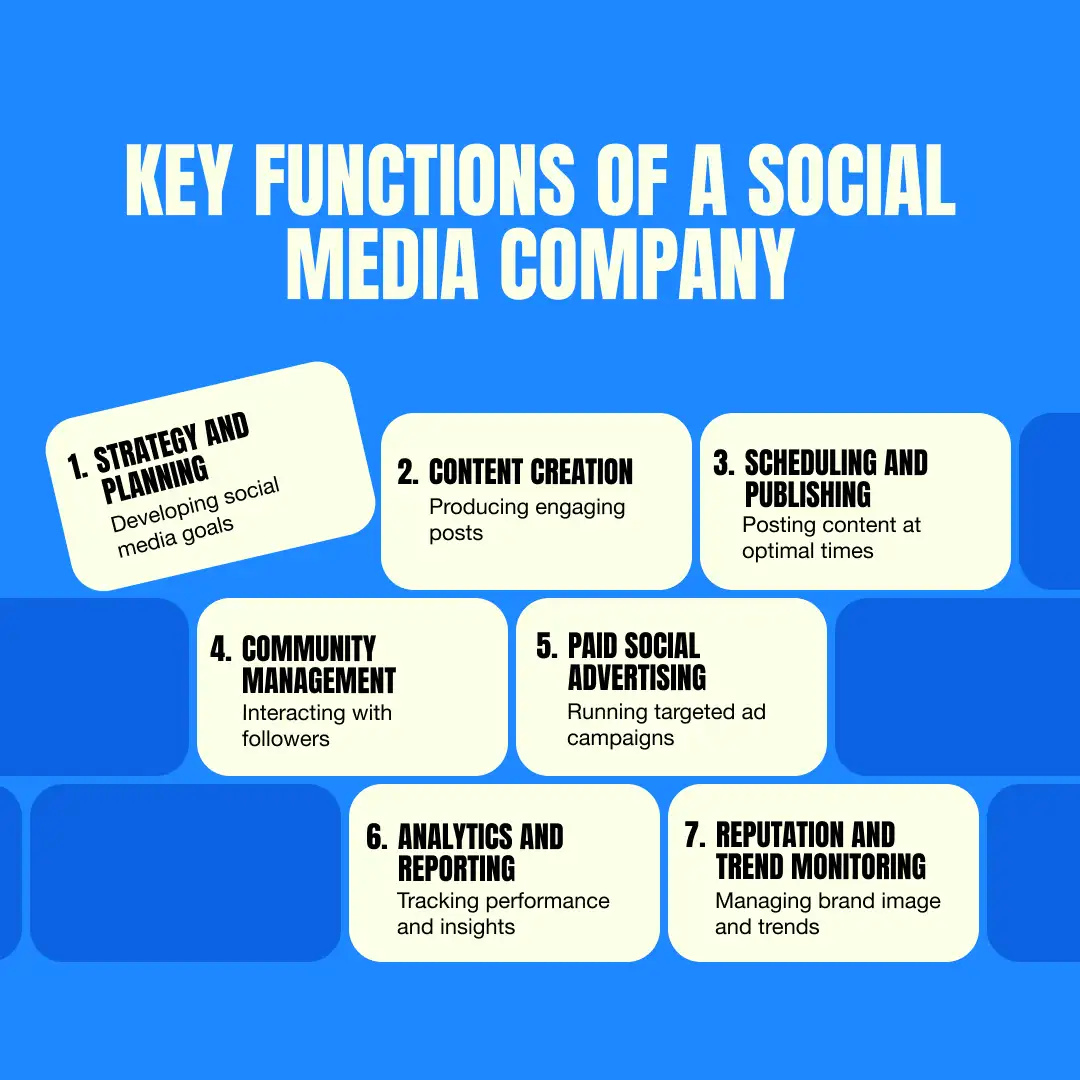
The job title sounds simple enough: manage social media. But that’s not it! The scope varies widely depending on who you hire and for what project. Here’s what a social media management company typically covers-
-
Strategy and Planning
Before anything gets posted, a good social media agency figures out why you’re on each platform in the first place. That means understanding your audience, your competitors, and what success actually looks like for your business. Without this step, everything downstream is guesswork dressed up as content.
-
Content Creation
This is the visible part for most social media marketing plans: the graphics, captions, videos, and posts that show up in someone’s feed. Most agencies now use AI tools somewhere in this process, whether it’s speeding up first drafts, generating variations to test, or handling routine production work that used to eat up hours.
The agencies worth hiring don’t let that replace human thinking; they use AI to move faster, not to decide what’s worth saying or how it should sound. That distinction is still what separates content that feels like your brand from content that just looks finished.
-
Scheduling and Publishing
Someone has to decide what goes out, when, and on which platform. Social media management companies do that consistently, without any gaps. It sounds mechanical, but timing affects reach more than you realize. Most companies use scheduling tools that suggest optimal posting windows based on past performance data.
-
Community Management
Comments, DMs, mentions, reviews- someone needs to be watching and responding to all of it, and quickly. Most social media marketing and management agencies use AI to flag urgent messages or draft quick replies to common questions. This genuinely helps with response time.
-
Paid Social Advertising
Organic reach only goes so far on most platforms now, so paid campaigns usually sit alongside content work, audience targeting, ad creative, budget management, and testing what actually converts.
Marketers use AI to handle a lot of the heavy lifting here too, from predictive audience targeting to automated bid adjustments that respond to performance in real time. This is a big part of why paid campaigns perform better today than they did even a couple of years ago.
-
Analytics and Reporting
Numbers on a dashboard don’t mean much without context. AI-powered analytics tools have changed what’s possible here; AI-powered marketing makes it easy to spot engagement patterns, audience behavior shifts, and content trends across weeks of data almost instantly. Reporting has moved from static monthly summaries to something closer to continuous, real-time insight.
-
Reputation and Trend Monitoring
Social platforms move fast, and so does public sentiment. AI-driven social listening tools now track mentions, sentiment shifts, and emerging conversations across platforms as they happen. It’s turned reputation management from a reactive scramble into something agencies can actually stay ahead of.

Want Social That Actually Moves the Needle?
Get the strategy, content, and reporting handled by a team that treats your brand's growth like their own KPI.
7 Steps to Choose the Right Social Media Management Company
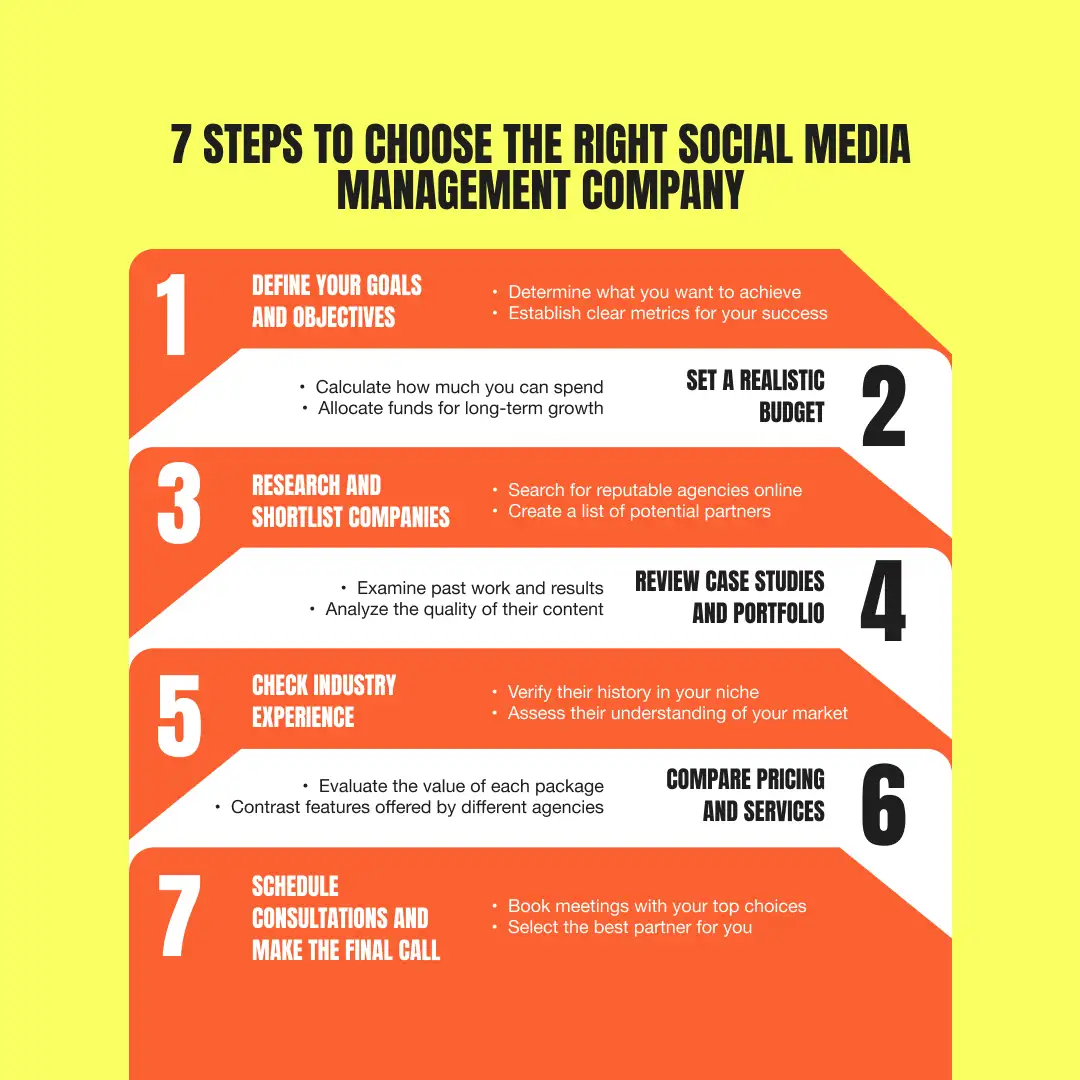
There’s no universal checklist to choose a social media agency that works for every business, but there is a sequence that holds up regardless of industry or budget. From what we’ve seen, both as an agency and from talking to businesses who’ve been through this, these are the steps that actually matter, in the order they matter.
-
Define Your Goals and Objectives
Before reaching out to a single agency, get specific about what you actually want: brand awareness, lead generation, customer support, community building, or some combination. Agencies build very different strategies depending on the actual objective, and vague goals almost always end up with vague results.
-
Set a Realistic Budget
Figure out what you’re willing to spend before you start collecting proposals, not after. Social media management cost varies enormously: a few thousand a month for basic content and posting, considerably more for full-service strategy, paid ads, and dedicated account management.
Walking into conversations without a number invites agencies to anchor the pitch around their pricing instead of your needs.
- Research and Shortlist Companies
Cast a wide net first: search results, referrals, industry recognition, agencies your competitors or peers use, then narrow it down to five or six that seem like a genuine fit. Look past the homepage. Check how they run their own social presence, since that says more than any pitch deck will.
- Review Case Studies and Portfolio
Ask for real client work, not just polished highlight reels. A strong case study shows the starting point, the strategy applied, and the actual outcome, not just a follower count that went up. If an agency can’t show specifics or gets vague about numbers, that’s worth noting before you go further.
- Check Industry Experience
An agency that’s worked with businesses like yours already understands the audience, the compliance concerns, and what tends to work, versus one that’s learning your industry on your dime. This isn’t a dealbreaker on its own, but it does change how much hand-holding you’ll need to do early on.
- Compare Pricing and Services
Once you’ve got two or three finalists, line up exactly what each one is offering for the price, content volume, platforms covered, paid ad management, reporting frequency and revision rounds. The most affordable option often looks affordable for a reason, and the most expensive one isn’t automatically the most capable. Compare scope, not just the number.
- Schedule Consultations and Make the Final Call
Talk to the actual team that would work on your account, not just the salesperson who ran the pitch. Ask who you’d be emailing when something needs fixing. The agency that answers that clearly, and means it, is usually the one worth signing with.
Why Choosing the Right Social Media Management Company Matters
Social media isn’t a minor budget line. The CMO Survey’s latest data puts current social media spend at roughly 14% of the average marketing budget, with marketers expecting that to climb to 17% within a year.
That’s a growing share of budget resting on one hire. So, you need to get this decision right and here’s what actually changes when you get it correct.
| What’s at Stake | Right Company | Wrong Company |
| Brand Voice | Stays consistent across platforms and over time | Shifts every time strategy changes, or accounts get reassigned |
| Customer Perception | First impressions and complaints get handled quickly and well | Slow replies, generic responses, or silence when it matters most |
| Strategy Continuity | Gets sharper over time as the team learns what works | Resets every time you switch agencies, losing months of learning |
| Budget Efficiency | Spend goes toward what’s actually driving results | Spend goes toward content and ads that look busy but don’t convert |
| Team Attention | Senior, experienced people stay involved | Account gets handed off to whoever’s available that week |
| Long-Term Growth | Compounds, month six looks better than month one | Plateaus early, or requires starting over with a new agency |
Key Questions to Ask Before Hiring a Social Media Management Company
Most sales calls answer the questions social media marketing agencies want to talk about. These are the ones worth asking instead.
On Strategy and Goals
- What do you know about our business so far, and what questions do you still have?
If they jump straight into a strategy pitch without asking much back, that’s usually a template, not a plan built for you.
- How much strategic direction will you provide versus just executing what we tell you?
Some agencies shape strategy; others just carry it out. Know which one you’re hiring before you sign, not after.
On Proof of Results
- Can you show me a case study from a business in a similar position to ours?
Vague success stories without specifics, no numbers, no context, usually mean there isn’t much to show.
- How exactly will you measure success on our account?
If the answer is just engagement or followers, push further. Those numbers rarely connect to actual business outcomes.
- Have you worked with businesses in our industry before?
Industry experience shortens the learning curve significantly; they already know the audience and what tends to work.
On Communication and Process
- How often will we hear from you, and through what channel?
Get this in writing. “We’ll keep you updated” means something different to every agency.
- If something needs fixing urgently, how do I reach you?
Ask this directly and watch how they answer. Hesitation here is usually a preview of what happens after you sign.
- Is this work done in-house, or do you outsource social media marketing?
Nothing wrong with specialized contractors, but you should know exactly who’s touching your account and where.
On Team and Capacity
- How many other accounts will the person managing ours be handling?
An account manager juggling twenty clients isn’t going to give your brand the attention a proposal implies.
On Pricing and Legitimacy
- Why is your pricing lower than the other agencies we’ve spoken to?
If the answer isn’t clear or specific, unusually affordable pricing almost always means cut corners somewhere.
- Can I see your own social media presence and how you manage it?
A social media management agency that doesn’t run a strong presence for itself raises a fair question about whether they can run one for you.
Red Flags to Watch Out For When Choosing an Agency
Some warning signs show up before you even sign a contract; you just have to know where to look. These are the ones worth paying attention to during the sales process-
| Red Flag | Why It Matters |
| Generic Pitches | Real customization should show up in the first conversation, not just the final proposal |
| Reluctance to Share Case Studies | Usually covers for a thin track record |
| Unusually Low Pricing | Affordable almost always means something’s being cut: junior staff, templated content, or minimal strategy work |
| Slow Communication Pre-Contract | If they’re slow while trying to win your business, it won’t improve once you’re a paying client |
| No Clear Point of Contact | Signals the account structure isn’t settled, or won’t be stable |
| Weak Presence on Their Own Platforms | An agency that can’t run its own presence well is unlikely to run yours better |
| Long Contracts With No Clear Exit | Confident agencies don’t need to trap clients in to keep them around |
| Overpromising Specific Results | Nobody can promise this upfront; agencies that do are setting expectations they likely can’t meet |

Tired of Spotting Red Flags Instead of Results?
Skip the guesswork and partner with Appinventiv Digital to get your social media management right from day one: no missed deadlines, no generic content, no radio silence.
How to Check an Agency’s Reputation
A polished website and a confident sales pitch only tell you so much. Reputation checks happen outside the conversations the agency controls, which is exactly why they matter. Here’s how you can check the reputation for a social media strategy agency before hiring them-
- Ask for client references, not just case studies
A case study is curated; a reference call isn’t. Ask to speak directly with a current or past client, and ask them what the agency doesn’t put in their proposals.
- Read online reviews, not just the ones on their homepage
Check Google reviews, or industry-specific platforms where feedback isn’t filtered by the agency itself. Pay attention to patterns across multiple reviews, not just one outlier.
- Look at how long their client relationships tend to last
Ask directly, or look for signs in case studies; multi-year partnerships usually mean consistent results. High turnover is worth asking about.
- Check their own social media presence
How an agency runs its own accounts is a fair preview of how they’ll run yours. Inconsistent posting, low engagement, or a stale feed says more than any pitch deck.
- Search for the agency’s name alongside terms like ‘review’ or ‘complaint’
A few negative results are normal for any company. A consistent pattern of the same complaint across multiple sources is not.
- Check industry recognition or rankings, but don’t rely on them alone
Awards and listicle placements can indicate credibility, but they’re often influenced by marketing budgets rather than actual client outcomes; treat them as one data point, not the deciding one.
Which Pricing Model Should You Opt For?
Social media agency pricing is usually based on one of a few ways. Each model fits a different kind of business need. Here’s how different social media management pricing packages compare.
| Pricing Model | How It Works | Best For | Watch Out For |
| Monthly Retainer | Fixed monthly fee for an agreed scope of ongoing work | Businesses wanting consistent, long-term management | Make sure the scope is clearly defined; “unlimited content” often isn’t |
| Project-Based | One-time fee for a specific deliverable, like a campaign or platform launch | Businesses with a defined, short-term need rather than ongoing management | Not suited for continuous account management or long-term strategy |
| Hourly Rate | Billed based on actual hours worked | Smaller businesses needing occasional, limited support | Costs can add up quickly and are harder to predict month to month |
| Performance-Based | Fees tied to specific outcomes, like leads or conversions | Businesses focused primarily on measurable ROI, especially for paid campaigns | Rarely covers full-scope social media management on its own; usually paired with a base retainer |
| Tiered Packages | Pre-set bundles (Basic, Standard, Premium) with fixed inclusions at each level | Businesses that want pricing clarity and the option to scale up later | Entry-level tiers can be limited in scope; check exactly what’s included before assuming it covers your needs |
Expert Tip: The right model ultimately depends on what you’re hiring the agency to do; a long-term brand-building partner needs a different arrangement than a business that just needs a three-month campaign push.
Contract Terms You Need to Review Before Signing a Social Media Marketing Agency
Your sales call with the agency will cover strategy and results; the contract that you will sign will cover how the agency will help if things go south. Here’s what you should check before signing the social media management contract –
| Contract Term | What to Check For |
| Scope of Work | Exact deliverables, post count, platforms covered, whether paid ads are included, number of revision rounds |
| Ownership of Content and Creative Assets | Confirmation that graphics, videos, and copy created for you belong to you, even after the contract ends |
| Account Access and Login Credentials | Admin-level access to your own social accounts, retained at all times, not just held by the agency |
| Confidentiality and Data Handling | A clear clause covering how customer data, ad accounts, or internal business information is stored and used |
| Performance Accountability | What happens if results consistently miss what was discussed at the start, even if it’s just a defined review checkpoint |
Run Your Next Social Media Strategy with Appinventiv Digital
A content calendar looks tidy in a proposal deck. It behaves differently once it’s competing for attention in a live feed against everything else fighting for the same three seconds. Here’s what changes when we’re the ones running it.
We don’t wait for a monthly report to catch a stalling campaign; we adjust format, timing, and spend the moment a platform’s algorithm shifts. That’s why accounts we manage see organic reach grow by 180% on average, LinkedIn followers compound at 3.2x within six months, and paid amplification kicks in the second a post shows early traction, not after it’s already cooled off.
Reach only means something if it’s engineered to hold up, so that’s where we start.
- For the Har Ghar Tiranga initiative, we had a 7-week window and a 55-million-citizen target. We rebuilt distribution around native, high-velocity content and reached over 200 million citizens, more than 3x the original goal.
- For the Government of Madhya Pradesh, we replaced flat organic posting with 100+ targeted creator integrations, taking engagement up 145% and building an active community of 1.7 million followers over three years.
- For Zoho, we skipped paid boosting entirely on a strategic video series and let organic distribution do the work, pulling in 2M+ reach on content built for exactly where their audience already was.
We don’t chase visibility with bigger budgets. We get there by knowing which lever, format, timing, or creator, moves the needle before the moment to capitalize on it passes.
Conclusion
Choosing a social media management company isn’t a one-time decision you make and forget; it’s a relationship you’ll need to actively manage, especially in the first few months. The steps in this guide aren’t meant to slow the process down; they’re meant to make sure the agency you pick is still the right one a year from now, not just the one that pitched best.
If you’re starting this search, here’s a practical way to move forward: shortlist three to five agencies, ask the direct questions covered here, request real client references, and read the contract line by line before signing anything.
If you’re currently evaluating options for your brand, or reconsidering an existing agency relationship, that’s exactly the kind of conversation we’re set up to have. Reach out to Appinventiv Digital, and we’ll walk you through how we approach social media management, with the same directness this guide is written in.